

What Stands Out Most Is The Value To Our Partners
For most of my career, I’ve been on the partner side supporting and leading services organizations for resellers. Each time there was a common goal: helping customers get more value from their technology through managed and value-added services. That work has been rewarding, but if you’ve spent time in this world, you also know how difficult it can be.
Early on, I helped build a NOC for a telecom reseller, much of it built using proprietary code. That experience gave me a real appreciation for standards and repeatability. If you want to scale and execute consistently, a uniform model based on standards is the best approach.
In the partner world, we were always trying to find a way to offer differentiation. We wrapped our offering with services like expense management for connectivity, change control processes, back up, patching, operational workflows and anything else that we believed created more value, which helped us build recurring services around it.
But there was always friction.
Every time we scaled, every time we added customers, every time a vendor changed something in the stack, there was more complexity to manage individual APs and switches, different OS versions, compatibility issues and SW upgrade concerns. More tooling. More staffing. More training. More process. And eventually more risk.
By the time I was building the fourth NOC of my career, this time for a legacy Juniper Networks environment, I knew exactly what was coming.
- The pressure of getting alerts and notifications right. Missed notifications. Customer frustration. Uncomfortable conversations.
- A variety of inevitable operational gaps.
- The constant balancing act of trying to build something scalable across dozens or hundreds of environments that are all slightly different.
That’s not because IT teams aren’t capable. It’s because the traditional model is incredibly hard to get right and every environment has unique requirements. The architecture starts the same but always differs. Security policies differ by location or device type. Expectations even change depending on the environment, staff and business.
We’ve all spent years trying to automate our way through the complexity by building dev teams, runbooks, integrations, and processes to improve efficiency at scale. Every customer had a different need which forced us to design in unique tweaks to make things work. We’ve made real progress in this area but the reality is there are inherent limits.
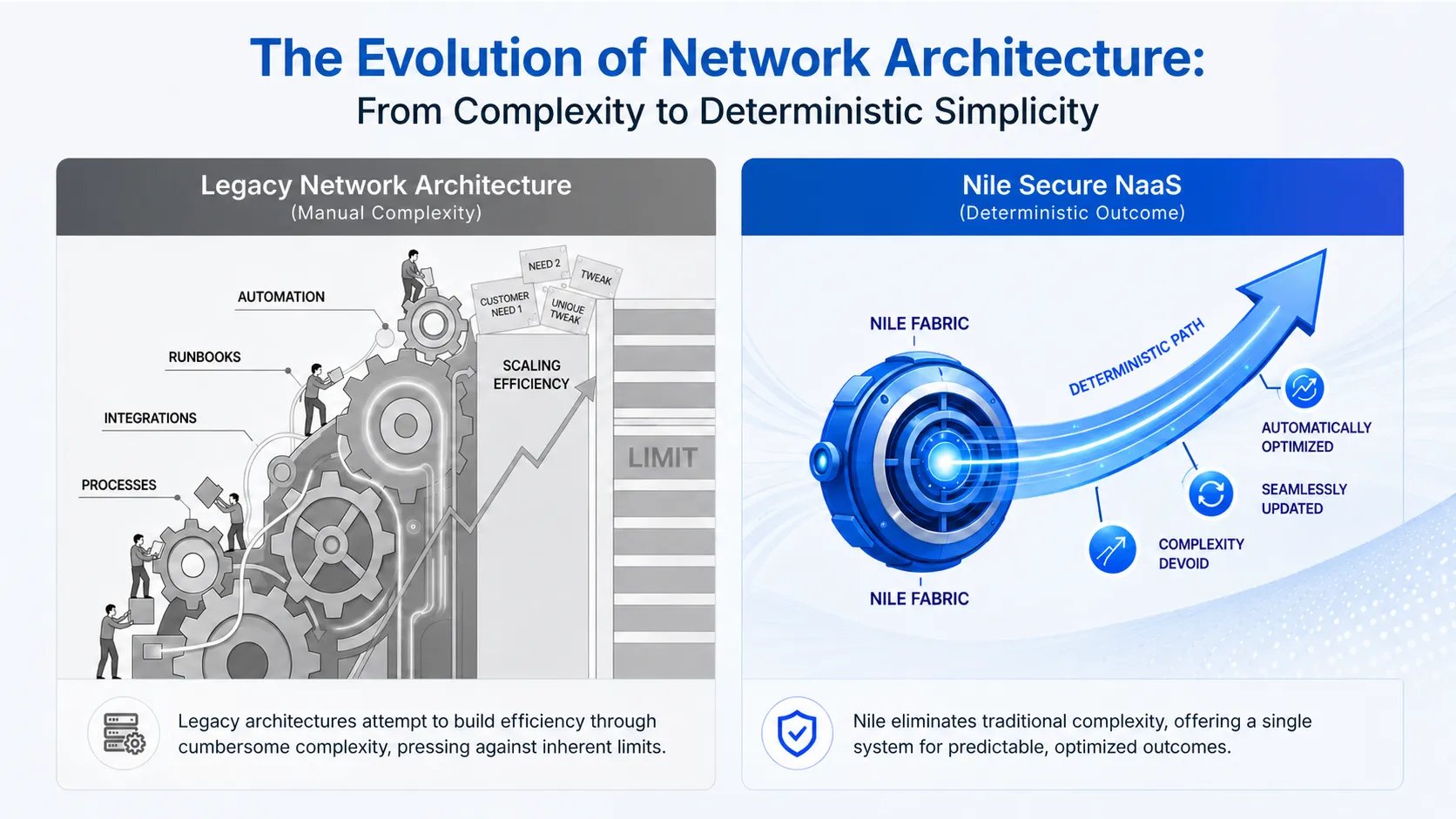
Customers often turn to managed services to offload that operational burden. But moving the problem to a MSP doesn’t eliminate the complexity, in reality it only shifts it to another team that has to manage dozens or hundreds of unique environments with the same staffing and tooling constraints.
The Nile Perspective
The reality is, I didn’t join Nile because I suddenly discovered something I hadn’t seen before. I already believed in the model. After spending decades building NOCs, developing services, and trying to automate operations at scale, the customer value proposition was obvious.
What I’m now gaining is a deeper appreciation for just how much operational burden our NaaS model removes, not just for customers, but for partners as well. That’s what continues to stand out to me every day. Another thing that hit me after joining Nile was how different the conversations are. For years, the conversations between partners and customers often started with network hardware choices, migration planning, staffing requirements, and operational ownership.
At Nile, the conversation shifts much earlier to outcomes. Security posture, operational improvements and predictable cost are areas we first cover. This may sound subtle, but after spending years in the traditional networking world, it’s a very meaningful change from technical consultation to business outcome identification and validation.
Partners no longer need to put themselves through the pain of building and maintaining a boat load of infrastructure just to drive recurring revenue and deliver outcomes. They can add on a meaningful new recurring revenue stream without having to build a NOC, hire around-the-clock certified staff, manage integrations, and continually reinvest in operational tooling.
That matters. Recurring services is the most valuable revenue in a partner portfolio.
And when you compare the Nile model to traditional hardware sales, and the services wrapped around it, the operational overhead is dramatically lower, exposure to customer dissatisfaction is reduced, and when executed well, the margin opportunity is very attractive.
To be clear, this doesn’t reduce the role of the partner. If anything, it gives partners the opportunity to focus on the work customers truly value.
For decades, we’ve built extensive operational capabilities to help customers run their networks. But customers don’t buy us for NOCs, complex tools, or operational processes, they buy us for our expertise. They value our ability to guide strategy, improve security, reduce risk, and help them modernize with confidence. As operational burdens disappear, that advisory role becomes even more important.
The Nile model creates more room for partners to focus on those outcomes instead of the operational burden behind them. Less time maintaining infrastructure and more time delivering business value.
That’s why I see this as a real win for customers, partners, and Nile alike.
The Winning Formula
The more time I spend at Nile, the more convinced I am that this is more than just another networking offering. It’s a shift in the way customers can and are designing, deploying, consuming, and maintaining secure wired and wireless environments. The comparison I keep coming back to is Amazon Web Services and what they did for compute and infrastructure consumption in the data center, Nile is doing the same for enterprise-class secure networking.
- Customers win because they get a secure autonomous wired and wireless network designed around outcomes, predictable spend, and operational simplicity.
- Partners win because they can expand their portfolio and grow recurring revenue without having to build and maintain the operational machinery behind the scenes.
- Nile wins because we’re helping modernize an industry that has been overdue for a simpler model.
I’ve spent a large part of my career building services around complex infrastructure, so it’s rare to come across a model that genuinely makes you stop and rethink how the industry can evolve in a way that saves people time and money, while delivering a better experience for all.