


Network Industrial Complex
It has always been the case that legacy IT infrastructure vendors drop ship a box or two at customer sites and simply ask them to “call back when something breaks”. Customers almost always are left alone when designing, installing and maintaining multiple generations of hardware products, software licenses and support contracts. Behind the scenes, fragmented hardware and monolithic software architectures seem to defend the operational complexity and inherent inefficiency. The infrastructure creaks under mounting technical debt. Countless hours in creating per-box golden configurations limit flexibility and speed of execution. It considerably increases risk for network intrusions, increasing cyber insurance cost for digital initiatives, as it adversely impacts overall security posture for the IT infrastructure.When the legacy house of cards falters, vendors extract more value via professional services. Expensive consulting engagements impose heavy "innovation taxes" on progress. In the last 30 years, each product innovation within IT infrastructures - and especially within enterprise networking - came with specific hardware SKUs, software releases, security overlays, licensing requirements and support contracts. The operational burden was left to the enterprise IT teams to navigate. Way more time and resources than expected were required to keep the infrastructure up and running. Complexity continued to climb with every budget, security and performance compromise that was made over the course of its lifetime.This legacy approach makes IT innovation dependent on and reactive to product choice, capital availability and business real-estate plans.
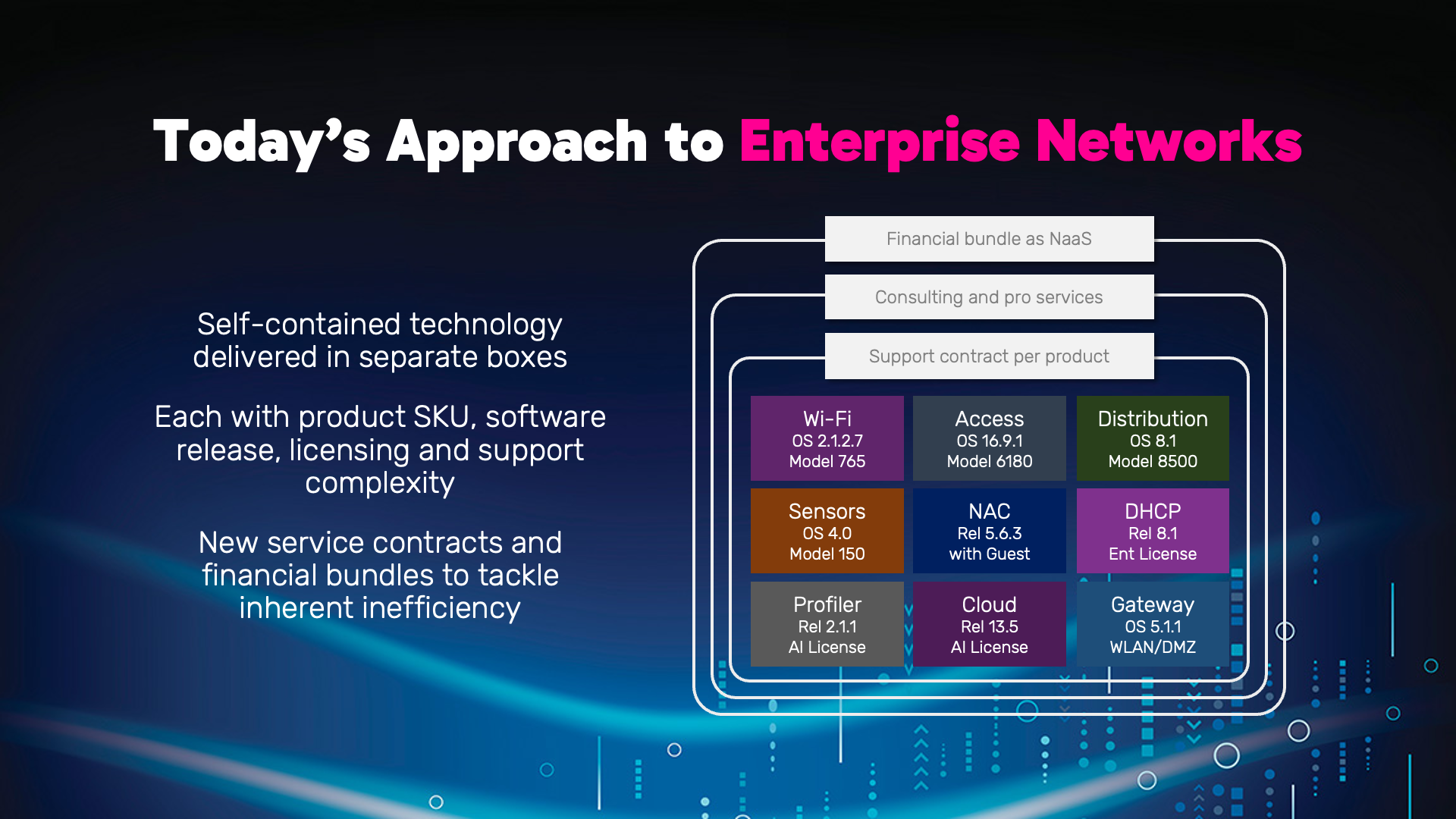 We call this the Network Industrial Complex. Here are its top-10 problems.
- Proliferating SKUs and software versions: Each new capability requires purchasing, integrating, and maintaining new hardware and software bundles. Just within campus and branch this means consumption of 10+ products and services.
- Poor visibility and control: With each element monitored separately, IT lacks holistic insight into utilization, and user experience. Granular control is almost impossible. There is absolutely no service level guarantee for coverage, capacity or availability. It is all left to chance to see if things break.
- Fragile policy enforcement: Security relies on manual changes across fragmented hardware and software solutions, considerably increasing risk. Zero trust security principles that are the cornerstone for cloud networking are nowhere to be seen.
- Lack of monitoring for blindspots: With limited device integrations, security teams lack visibility into network activity relevant to threat detection.
- Uncoordinated updates: Security vulnerabilities and patches are addressed in isolation, rather than holistically, further increasing exposure.
- Manual, error-prone management: Every function demands custom configuration across multiple elements. This makes Quality of Service (QoS) and infrastructure security policy definitions complex and fragile.
- Impossible to enable closed-loop automation: It continues to be an elusive goal in legacy environments due to fragmented data and controls.
- Inefficient workflows: IT teams rely on manual, multi-step processes for provisioning, troubleshooting, and maintenance - impeding their agility to respond to business needs.
- Reactive vendor support: Issues are reported to vendors after-the-fact, delaying remediation. Problems linger while awaiting vendor response.
- Incohesive troubleshooting: Disjointed alerts and reports require manual correlation. IT teams continue to hunt for a resolution as they reactively analyze reported incidents.
- Is hiding the complexity away the right answer?
- Would it make sense to trust the network industrial complex to address these issues?
- Why don’t we start with a clean sheet of paper, with new principles, and look beyond the roadmap of legacy infrastructure vendors?
New Innovation Principles
Next generation of enterprise networks hence call for unifying network engineering, zero trust security, and traditionally manual lifecycle management in a single intelligent system designed for full stack integration and automation. Thankfully, we have some hope. Here at Nile, we propose new innovation principles for secure connectivity to break the mold of incumbent product centric solutions of the last 30+ years.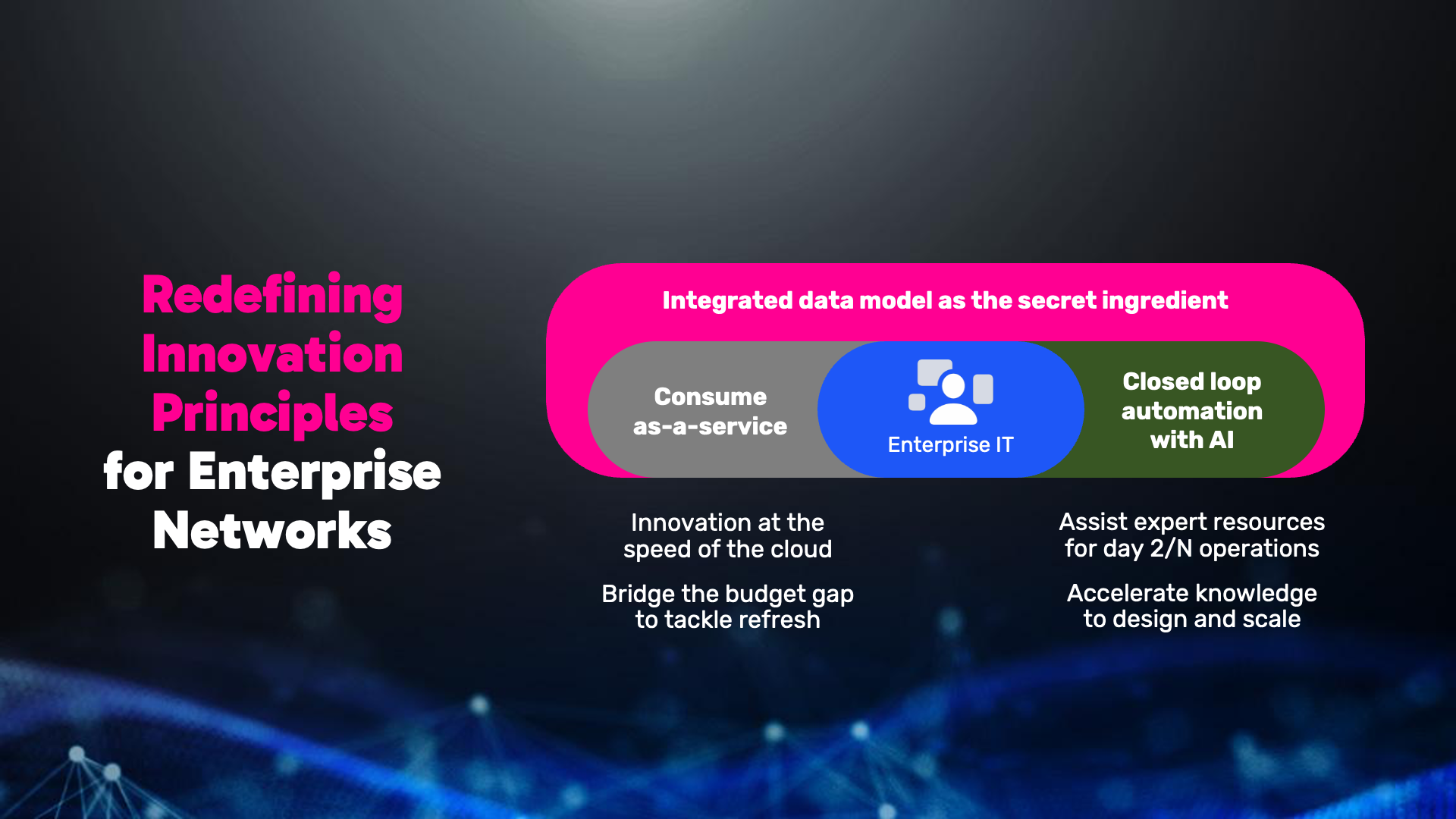 Today, IT organizations of any size and individuals across a wide ranging set of industries, can boost their innovation and productivity through digital innovations powered by data. It is now possible to transform knowledge into intelligence by organizing, manipulating and learning from vast amounts of data in our personal and work lives.
Today the cost of storing, analyzing and making sense of business and customer data has gone down drastically, thanks to cloud data warehouses such as Snowflake and Databricks. Definition of the 2020s as “the decade of data” has been stamped a few more times with the arrival of generative AI, pushing the boundaries of making digital innovation available to every organization and every one in the workforce.
Applications that take advantage of these platforms can drive more intelligence and improved simplicity for the digital tools that they enable: e.g. Verkada for physical safety across workplaces, Toast for digital experiences across restaurants, among many others. This massive wave of innovation also brings a new dimension to how we think about the consumption and maintenance of enterprise IT infrastructures.
This renaissance in artificial intelligence (AI) over the last few years has opened up the possibility of using machine and deep learning technologies to automate design, deployment and management of IT infrastructures.
Today, IT organizations of any size and individuals across a wide ranging set of industries, can boost their innovation and productivity through digital innovations powered by data. It is now possible to transform knowledge into intelligence by organizing, manipulating and learning from vast amounts of data in our personal and work lives.
Today the cost of storing, analyzing and making sense of business and customer data has gone down drastically, thanks to cloud data warehouses such as Snowflake and Databricks. Definition of the 2020s as “the decade of data” has been stamped a few more times with the arrival of generative AI, pushing the boundaries of making digital innovation available to every organization and every one in the workforce.
Applications that take advantage of these platforms can drive more intelligence and improved simplicity for the digital tools that they enable: e.g. Verkada for physical safety across workplaces, Toast for digital experiences across restaurants, among many others. This massive wave of innovation also brings a new dimension to how we think about the consumption and maintenance of enterprise IT infrastructures.
This renaissance in artificial intelligence (AI) over the last few years has opened up the possibility of using machine and deep learning technologies to automate design, deployment and management of IT infrastructures.
Nile’s approach to AI networking has been designed to democratize innovation across the IT infrastructure design, deployment and maintenance at the enterprise campus and branch. Our adaptive systems automate operations end-to-end, and have been purpose built to eliminate budget, time, knowledge and resource gaps. Here are three key innovation principles for Nile in the field of AI Networking:Resulting set of innovations within enterprise networks is termed “AI Networking”.
- Eliminate Skills Barriers: With closed loop automation powered by AI, complex tasks that previously required niche expertise and lots of manual labor are no longer. Our systems configure, optimize, troubleshoot, and defend the network autonomously.
- Abstract Complexity: Intent-based user experiences and interfaces for IT admins, end users and our production engineering team mask infrastructure complexity. IT admins declare desired business outcomes, not technical implementations, freeing them to focus on innovation, not network element specific configurations. Zero trust security within the campus and branch network is not an option - it’s essential.
- Accelerate Innovation Cycles: By automating operations, and with an agile edge IT infrastructure, enterprises can roll out and refine services faster. Moves, adds and changes that once took weeks can now be completed within minutes.
Nile Access Service
Here at Nile, we join others who move to bring automation to all aspects of their technology solutions for organizations of all sizes. We do so by bringing data centric design, zero trust security and continuous automation with AI to enterprise networks. Our journey started by translating the enterprise network at campus and branch locations to an infrastructure-as-a-service model, taking advantage of the principles proven out in the cloud. This attempt has been rightfully labeled as NaaS (network as a service) although it simply acted as the first chapter in our innovation agenda to redefine consumption of IT infrastructures at the enterprise edge.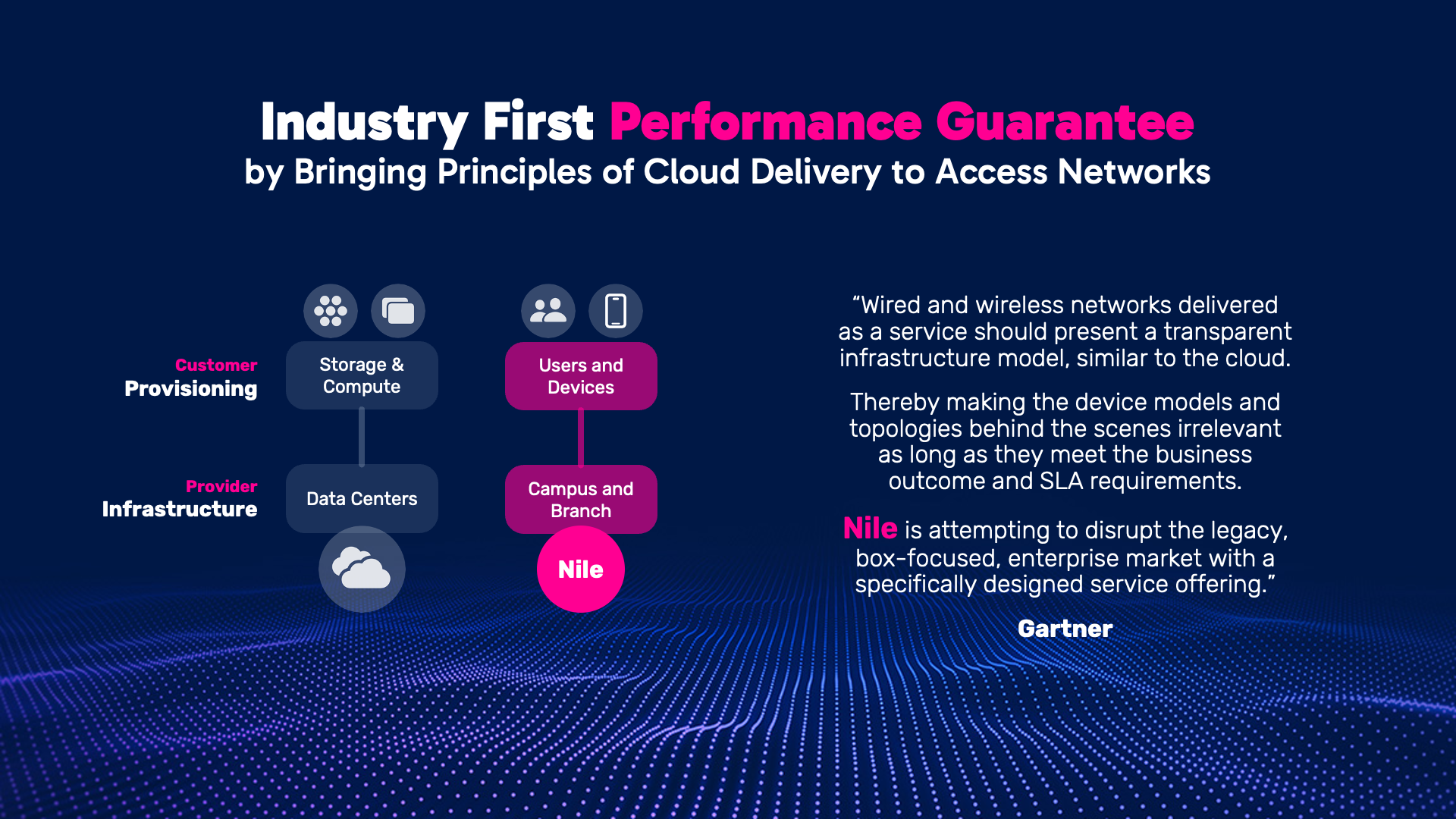 First piece of the puzzle - delivering a wired and wireless network completely as-a-service by utilizing these innovation principles - was our entry into the market. This allowed us to validate our cloud software and data models, and enabled the development of our AI applications. Across deployments of all sizes, we were able to prove our customer outcomes with a full tech stack design, delivery and lifecycle management of secure connectivity.
Here are a few examples of how Nile is helping them reclaim time, reduce business risk and redirect resources:
Eliminate network related IT tickets: proactively resolve deviations in service quality
“Nile sensors continuously monitor and test for any potential issues. We learn if & how users might experience connectivity issues before they happen.” - Lunar Energy
Up to 25x faster external issue resolution: automatically identify and visualize root cause
No touch software maintenance: orchestrate rollouts with pre/post-validation
“Knowing that Nile is managing updates and security patches – and testing them before they’re pushed out – gives me peace of mind. We have our weekends back.” - Uniphore
Continuous security compliance: guarantee zero trust isolation for each device
“As part of renewing our cyber insurance, the carrier reviewed our network security posture. With our Nile network, we actually lowered our premium.” - SDI
Built-in system care and upkeep: automate additions, replacements and refresh
“We wanted to move away from the traditional ‘break-fix’ model for our infrastructure. Nile prevents us from being held hostage by maintenance tasks.” - University of Denver
Centralized orchestration of Nile’s Access Service across many tenants was validated in the real world. This all happened while legacy product vendors were trying to figure out what NaaS truly is; and according to Gartner’s definition above, they are not even close.
First piece of the puzzle - delivering a wired and wireless network completely as-a-service by utilizing these innovation principles - was our entry into the market. This allowed us to validate our cloud software and data models, and enabled the development of our AI applications. Across deployments of all sizes, we were able to prove our customer outcomes with a full tech stack design, delivery and lifecycle management of secure connectivity.
Here are a few examples of how Nile is helping them reclaim time, reduce business risk and redirect resources:
Eliminate network related IT tickets: proactively resolve deviations in service quality
“Nile sensors continuously monitor and test for any potential issues. We learn if & how users might experience connectivity issues before they happen.” - Lunar Energy
Up to 25x faster external issue resolution: automatically identify and visualize root cause
No touch software maintenance: orchestrate rollouts with pre/post-validation
“Knowing that Nile is managing updates and security patches – and testing them before they’re pushed out – gives me peace of mind. We have our weekends back.” - Uniphore
Continuous security compliance: guarantee zero trust isolation for each device
“As part of renewing our cyber insurance, the carrier reviewed our network security posture. With our Nile network, we actually lowered our premium.” - SDI
Built-in system care and upkeep: automate additions, replacements and refresh
“We wanted to move away from the traditional ‘break-fix’ model for our infrastructure. Nile prevents us from being held hostage by maintenance tasks.” - University of Denver
Centralized orchestration of Nile’s Access Service across many tenants was validated in the real world. This all happened while legacy product vendors were trying to figure out what NaaS truly is; and according to Gartner’s definition above, they are not even close.
It starts with the novel idea that an enterprise networking technology vendor has to share the responsibility of outcomes with enterprise IT leaders, by offering a service level guarantee for network capacity, wireless coverage and overall system availability across all its customer deployments. With the Nile Access Service, violations in the promised %99.95 service level guarantee across any site translate to monthly credit paybacks. Here are the Nile architecture components: Nile Service Blocks: Edge network infrastructure, designed and delivered by translating infrastructure-as-a-service (IaaS) principles of the cloud to secure wired and wireless connectivity at the enterprise campus and branch. Nile Services Cloud: Powered by comprehensive data collection from the Nile Service Blocks, Nile Services Cloud enables real-time observability and continuous optimization, by utilizing both model-centric and data-centric AI. Nile AI Applications: Taking advantage of the integrated data model within the Nile Services Cloud, they not only provide full control and visibility to IT admins, end users and Nile’s production engineering team - but they also help orchestrate the network lifecycle management via simple and intuitive interfaces.Now, it is time to complete this picture and highlight how Nile is integrating AI Networking principles into its solution architecture.
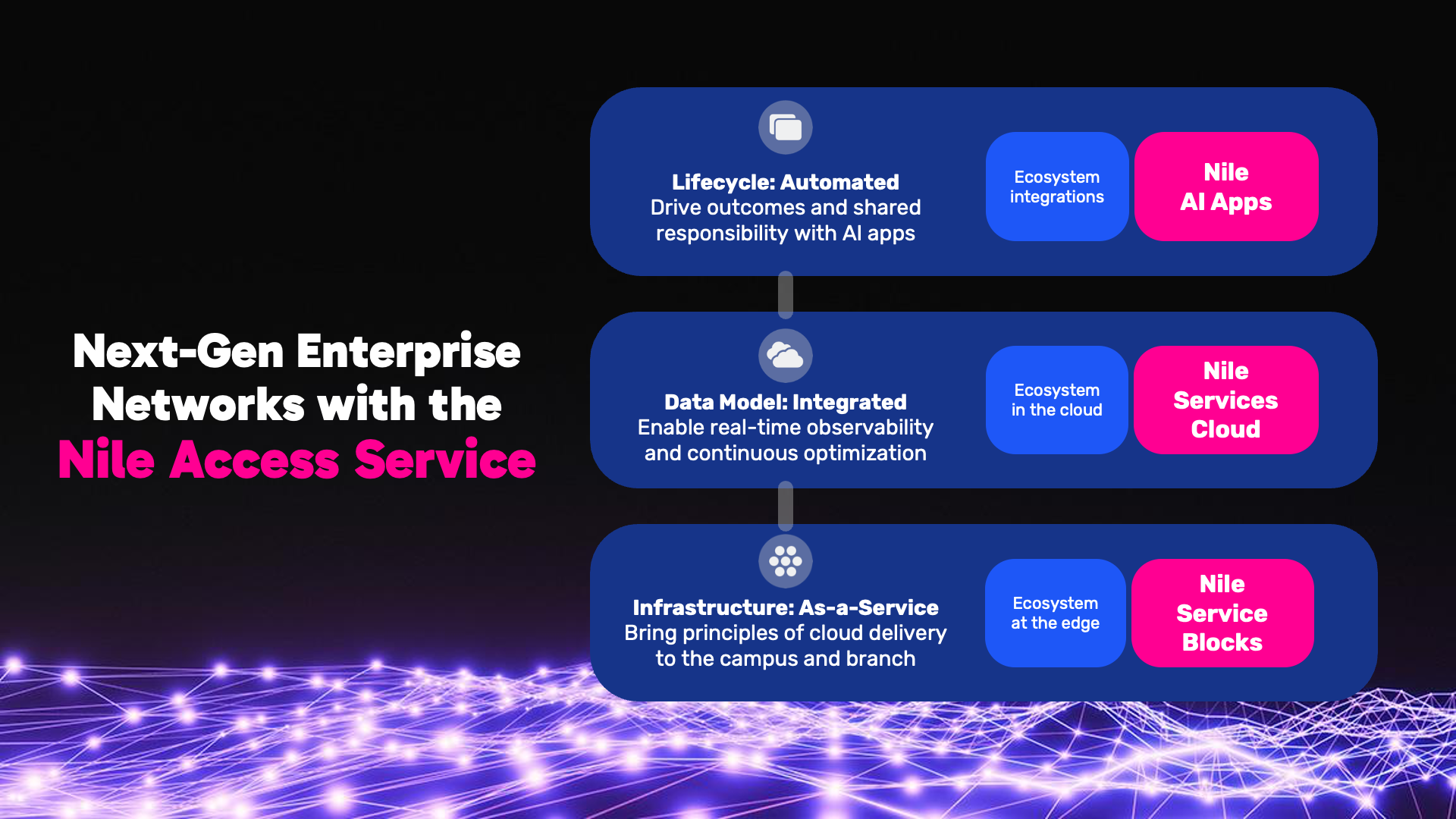 With a modern cloud-native technology architecture, Nile Access Service reduces complexity in building extensions on top of its core elements.
Technology partners in our ecosystem get to build on a solid foundation, with every Nile network using the same cloud software release and standardized infrastructure design, eliminating “snowflake” deployments. This enables Nile ecosystem partners to rapidly build and easily streamline support for highly differentiated solutions, and prevents surprises as they tackle joint customer deployments. Since the Nile Access Service integrates 10+ traditionally separate enterprise network products and services into a single solution, there’s no need for technology providers to build integrations with disparate components.
With a modern cloud-native technology architecture, Nile Access Service reduces complexity in building extensions on top of its core elements.
Technology partners in our ecosystem get to build on a solid foundation, with every Nile network using the same cloud software release and standardized infrastructure design, eliminating “snowflake” deployments. This enables Nile ecosystem partners to rapidly build and easily streamline support for highly differentiated solutions, and prevents surprises as they tackle joint customer deployments. Since the Nile Access Service integrates 10+ traditionally separate enterprise network products and services into a single solution, there’s no need for technology providers to build integrations with disparate components.
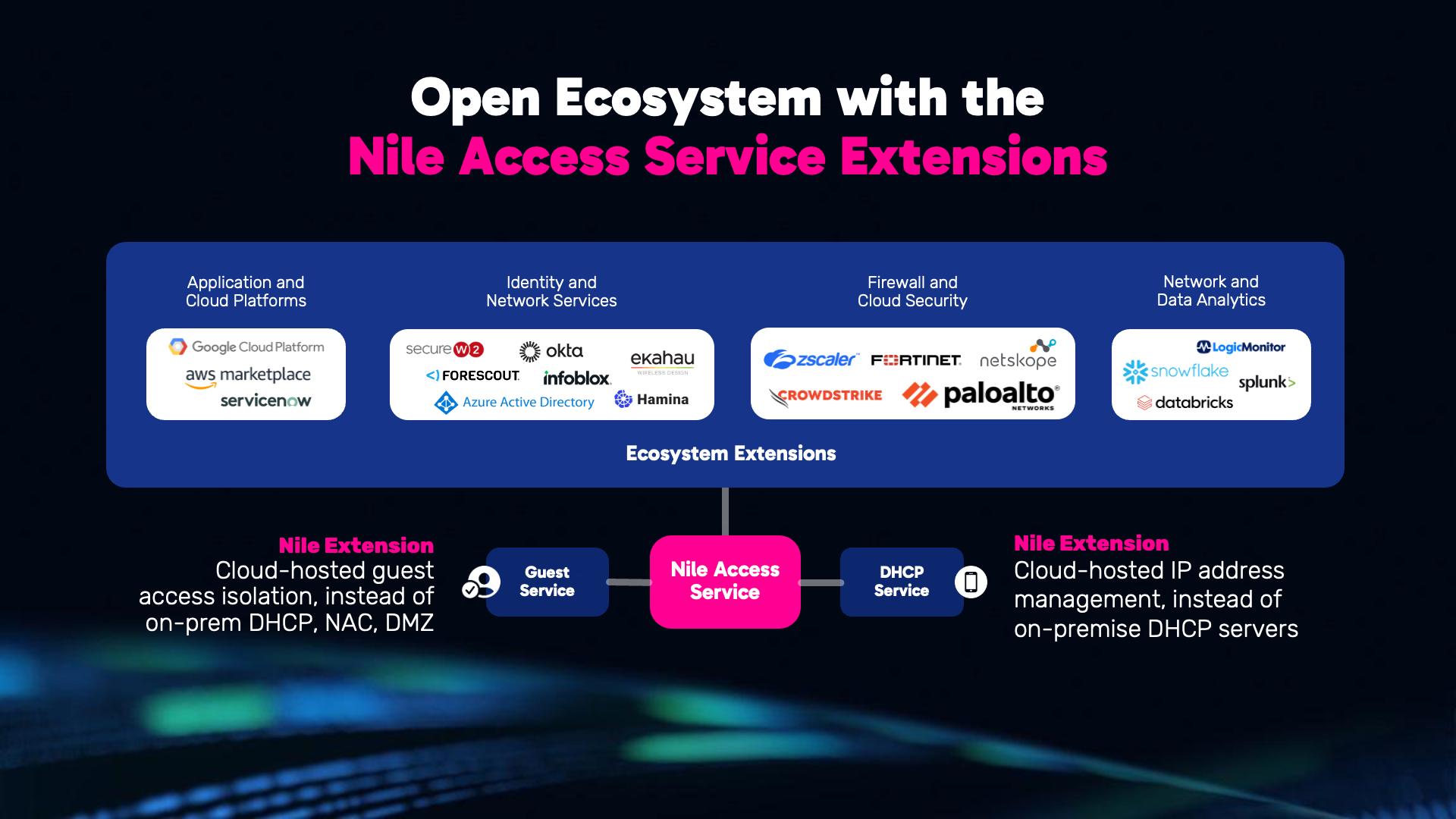 In order to accelerate adoption of the Nile Access Service, we also provide native extensions as optional add-ons to the core service: Nile Guest Service and the Nile DHCP Service.