


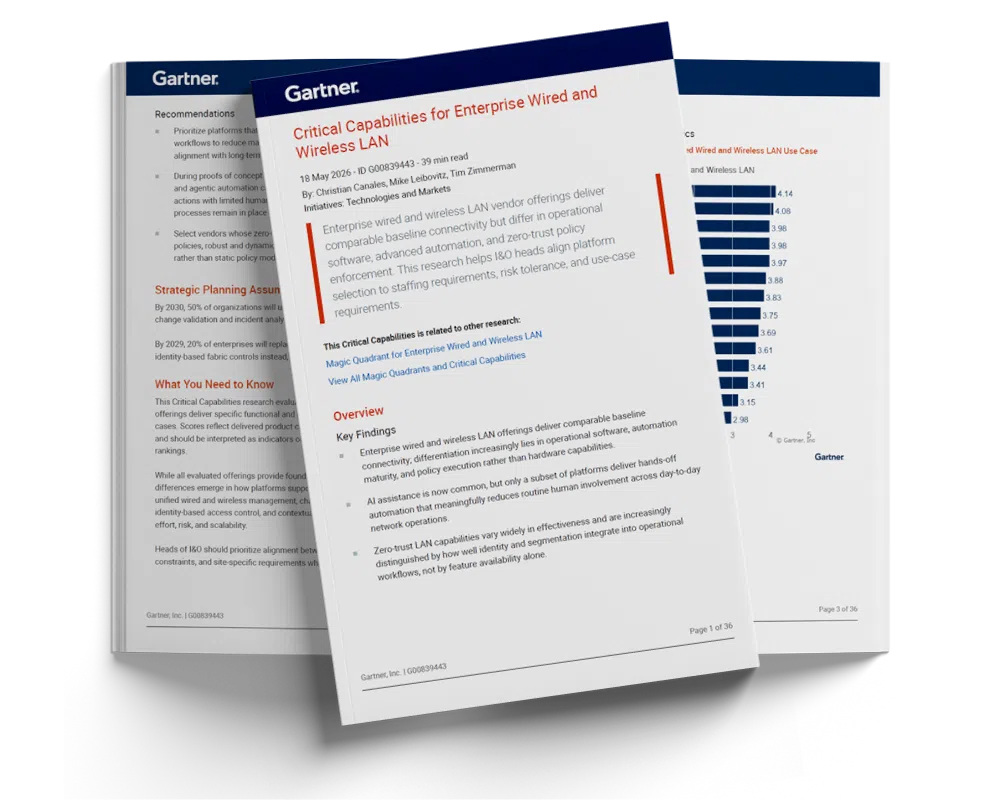
The 2026 Gartner® Critical Capabilities for Enterprise Wired and Wireless LAN report states plainly that “enterprise wired and wireless LAN offerings deliver comparable baseline connectivity; differentiation increasingly lies in operational software, automation maturity, and policy execution rather than hardware capabilities.”
At Nile, we didn’t layer differentiating capabilities on top of a legacy architecture and operating model. Legacy networks fail to natively address operational complexity, visibility limitations, reactive troubleshooting, and security gaps, forcing IT teams to spend their time keeping the network running instead of advancing the business. We built a modern, secure network-as-a-service (NaaS) from the ground up to address the contemporary challenges that matter most to network and security teams.
The critical capabilities Nile delivers fall into four key areas; autonomous operations that meaningfully free up IT resources, built-in Zero Trust enforcement, safer and faster change management, and flexible, enterprise-grade deployments that scale effortlessly while greatly reducing the network’s total cost of ownership (TCO) across the organization.
Industry Report
Download Gartner® 2026 Critical Capabilities Enterprise Wired and Wireless LAN Report
1. Autonomous Operations that Erase Guesswork
“AI-assisted” and “autonomous” are not the same thing. AI assistance is now common, but only a subset of platforms deliver hands-off automation. The goal is to meaningfully reduce routine human involvement, not to provide a human with a list of things to try.
Autonomous operations doesn’t just point you to what needs to be fixed or reconfigured, it automatically acts deterministically and predictably to identify and remediate issues. The speed and accuracy of execution, along with the drastic reduction in manual interaction required of IT teams, is a transformative leap forward, preventing the bottlenecks, human errors, and hours spent fixing common issues that are currently plaguing IT in environments still using traditional network architectures.
Autonomous Operations are the beating heart of Nile’s Secure NaaS:
- Unified management grants a single view across wired and wireless.
- Life-cycle automation from pre-deployment through ongoing operations.
- Continuous telemetry analysis to detect, validate, and remediate issues
- Radio resource management optimizes wireless connectivity.
The goal of Autonomous Operations is not to add pretty visuals to a dashboard and AI that identifies issues found in an outdated architecture, with a list of “actions” to manually perform. IT teams have become leaner and do not scale in proportion with the rest of the business or with the escalating demands of modern environments, so there is a significant benefit to freeing limited resources from the tedium of dashboard babysitting, ticket floods, and manually chasing down routine maintenance tasks.
The true value lies in having a network that runs itself, scales effortlessly, and actively strengthens the operating posture of the entire business.
2. Native Zero Trust Built into the Network Fabric
Alignment with Zero Trust principles varies widely among networking solutions, and is increasingly judged by how well identity and segmentation capabilities integrate into operational workflows. Connecting the desire for Zero Trust networking to real-world enforcement is a significant challenge, with legacy architectures relying on a complex sprawl of NAC, VLANs, ACLs, EDR, firewall, cyber-physical systems security, and other specialized solutions.
Gartner expects one in five enterprises to replace campus NAC with identity-based fabric controls by 2029. We consider that number far too conservative, but it’s easy to be bullish when you’ve already built the solution and stress-tested it against some of the most gifted white hats on the planet.
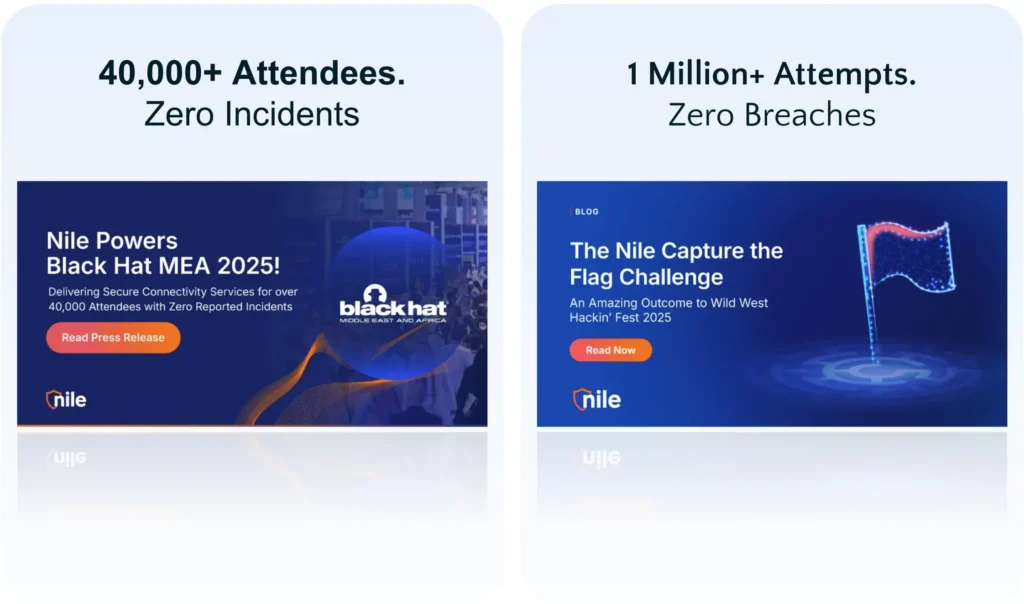
Nile’s Secure NaaS was built to enforce Zero Trust natively as a foundational element of the fabric itself. Every user and device authenticates at the point of connection and lands in a segment of one — isolated by default and permitted to communicate only through pre-approved channels.
There’s no need for VLANs, ACLs, or bolted-on NAC appliances to license, tune, and babysit. Nile’s identity-centric model applies to all users and devices, with automated threat response that quarantines compromised or vulnerable devices.
3. Ending The Fear of Change
Gartner calls out two capabilities aimed at addressing problems known for disrupting network operators’ personal lives late at night or on weekends; validating changes before they break something and catching configuration drift once it creeps in.
Regarding change validation, we agree completely. Nile’s continuously updated digital twin and sensor-driven telemetry validate changes before and after they go live, with safe rollback if outcomes diverge from intent.
With configuration drift, we take a different view. The best way to remediate it is to eliminate the conditions that create it. Legacy networks drift because they’re built on manually applied VLANs, ACLs, and per-box configs, so site-to-site and box-to-box consistency slowly erodes over time.
In contrast, Nile’s standardized, deterministic architecture removes the manual configuration and one-size-fits-none approach that leads to drift. In the Nile architecture, a configuration change can be applied across the entire environment with predictable, reliable outcomes, effectively unifying change management and eliminating the need for configuration drift solutions in the first place.
4. An Open, Enterprise-Grade Network Delivered as a Service
Gartner lists flexible licensing as a key differentiator in the enterprise wired and wireless LAN market. Nile is purchased through a single, predictable, outcome-based subscription with a financially-backed SLA designed to guarantee user outcomes. Organizations can walk away from the depreciation penalty and the operational tax of owning infrastructure, and consume the network in the same way they already consume ITSM, EDR, cloud storage, and other solutions.
Nile offers a full hardware portfolio of enterprise-grade switches, access points, sensors, and gateways as part of the Nile Access Service. Nile’s NaaS delivery model gives organizations a flexible, extensible network that scales with the business. This approach eliminates large upfront capital costs, reduces the complexity and expense of traditional network ownership, and makes network spending more predictable across the service lifecycle.
An Enterprise LAN Foundation for the Future
In the 2026 Gartner® Critical Capabilities for Enterprise Wired and Wireless LAN report, Gartner advises organizations to “prioritize platforms that offer robust automation capabilities” and “select vendors whose zero-trust LAN capabilities support highly granular access policies.”
At Nile, these recommendations resonate so deeply because Nile’s Secure NaaS was specifically designed to operate with minimal human intervention, continuously enforce least-privilege access, make change safely and predictably, and deliver consistent outcomes across every environment. We feel there is now a convergence of the capabilities networks are expected to deliver and the value our NaaS brings to our customers.
If you’d like to meet with our experts to discuss how Nile’s Secure NaaS can help in your environment, please request a demo.