

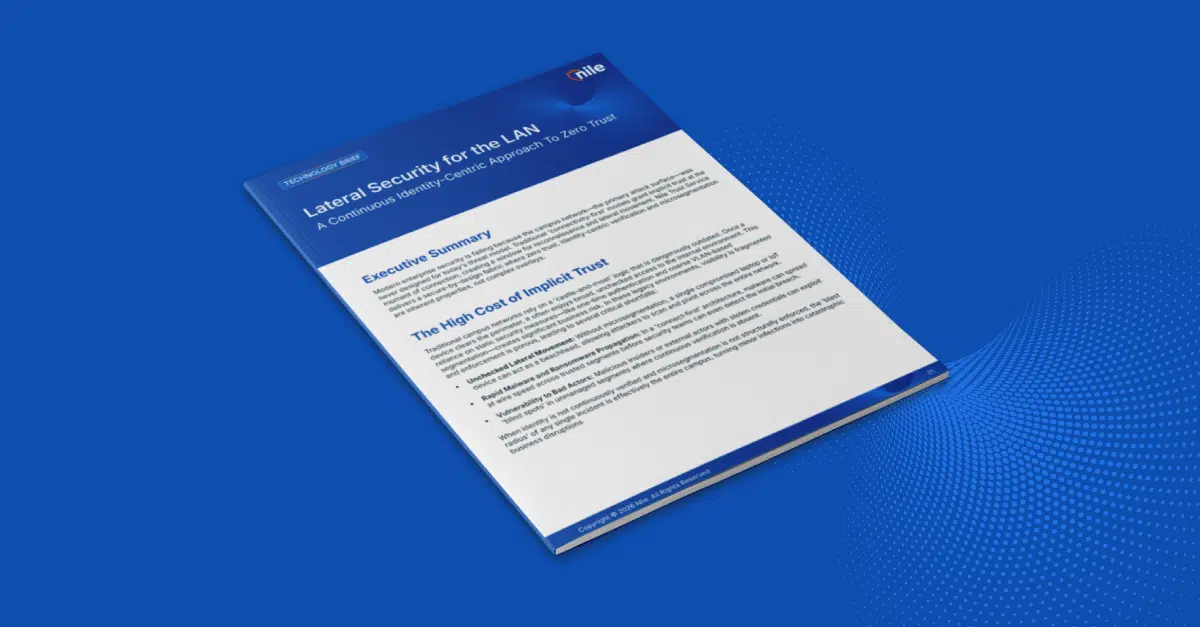
Why One-time Network Logins Fail Compliance
Modern enterprise security is failing because the campus network, which is the primary attack surface in your organization was never designed for today’s threat model. The traditional 'connectivity-first' models grants implicit trust at the moment of connection, creating a window for reconnaissance and lateral movement.
Nile Trust Service delivers a secure-by-design fabric where zero trust, identity-centric verification is built-in, eliminating expensive Zero Trust projects that are never fully completed.
The High Cost of Implicit Trust
Traditional campus networks rely on a 'castle-and-moat' logic that is dangerously outdated. Once a device connects, it often enjoys broad, unchecked access across the internal environment unless strict enforcement rules are applied. This reliance on static security measures, like one-time authentication and coarse VLAN-based segmentation creates significant business risks. In legacy environments that over 98% of organizations run, visibility is fragmented and enforcement is porous, leading to several critical shortfalls:
- Unchecked Lateral Movement. VLANs allow a single compromised laptop or IoT device to act as a beachhead, allowing attackers to scan and pivot across the entire network.
- Rapid Malware and Ransomware Propagation. In a 'connect-first' architecture, malware can spread at wire speed across trusted segments before security teams can even detect the initial breach.
- Vulnerability to Bad Actors. Malicious insiders or external actors with stolen credentials can exploit 'blind spots' in unmanaged segments where continuous verification is absent.
When identity is not continuously verified and microsegmentation is not structurally enforced, the 'blast radius' of any single incident is effectively the entire campus, turning minor infections into catastrophic business disruptions.
The Foundation: The Nile Zero Trust Fabric
- Zero Trust designed to isolate evolving threats and lateral movement
- LAN security as trustworthy as SSE/ZTNA solutions
- No complex add-ons required, saving time and resources
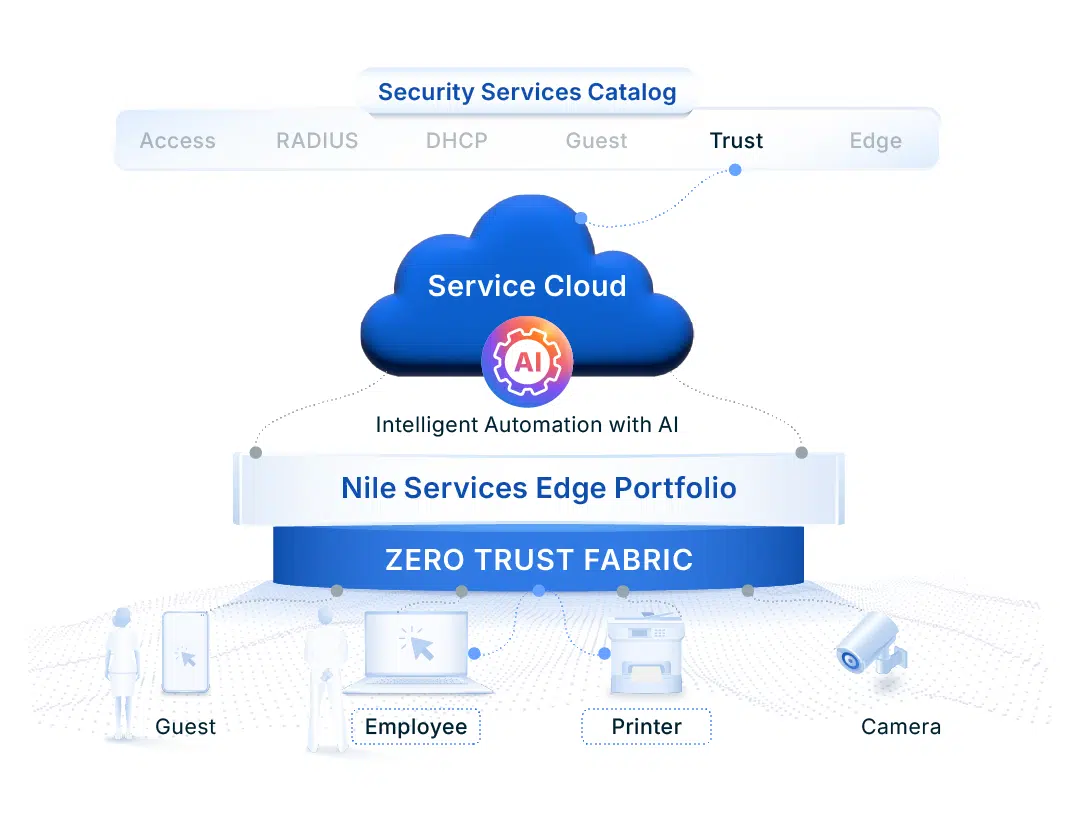
The Nile Zero Trust Fabric connects every guest, employee, printer and camera through the Nile Services Edge Portfolio. Above it, the Service Cloud provides intelligent automation with AI and a Security Services Catalog of Access, RADIUS, DHCP, Guest, Trust and WAN connectivity services.
100% Visibility through Zero Unauthenticated Access
Continuous identity verification is impossible without total visibility. Traditional networks suffer from 'dark matter'. Namely, unknown and unmanaged devices that connect to open ports without oversight.
Nile eliminates this by enforcing zero unauthenticated access across all wired and wireless ports. Because the network does not permit 'plug-and-play' intrusions, it achieves 100% visibility of every connected wired and wireless device. This comprehensive endpoint inventory is the mandatory starting point for a continuous identity-centric model.
The Engine of Identity: Continuous Device Fingerprinting
Nile’s built-in fingerprinting engine transforms raw connectivity into verifiable identity. By analyzing multi-signal data - including MAC/OUI, DHCP, and DNS transactions. Nile automatically classifies every IT, IoT, OT or IoMT endpoint the moment it connects. Unlike traditional NAC, which often stops at the "front door," Nile’s fingerprinting is continuous and adaptive, monitoring for "identity drift" or OS shifts that signal potential spoofing.
Customer benefits
- Low-Touch Onboarding. Eliminates manual MAC-list management by automatically placing device classes (e.g., "All HP Printers") into the correct segments.
- Agentless Spoofing Protection. Continuously validates device attributes to detect if a rogue host is impersonating a legitimate device, such as a camera or PLC, without requiring endpoint software.
- Elimination of NAC Complexity. Delivers full endpoint profiling and access control natively within the fabric, removing the need for separate, complex NAC appliances.
Microsegmentation: Default-Deny and Fine-Grained Control
Nile transforms microsegmentation from a manual configuration project into an architectural certainty. By moving away from brittle VLANs and ACLs, Nile enforces a 'Segment-of-One' for every host.
- Default-Deny Architecture. Nile operates on a strict default-deny model. No communication is permitted—either East-West or North-South—unless an explicit policy is in place. This ensures that unauthorized traffic is blocked by design, not just by filter.
- Fine-Grained Policies. Administrators define granular, identity-based policies that dictate exactly which users, devices, and applications can communicate. These policies are decoupled from IP addresses or physical location, remaining consistent as the device moves.
- Blast Radius Limitation. This structural isolation ensures that a compromised device is instantly contained, unable to scan or infect even its nearest neighbor, effectively neutralizing lateral movement.
Continuous Identity-Centric Verification
Nile moves beyond one-time login checks to a model of persistent validation, ensuring trust is re-verified with every flow.
- Fingerprint Drift Detection. Nile continuously monitors device behavior. If a device’s fingerprint changes—indicating potential MAC spoofing or impersonation—the fabric detects the 'drift' and triggers immediate isolation.
- Impossible Time-Travel. By correlating identity and location in real time, Nile blocks sessions where the same credentials appear in two physically separate locations simultaneously.
- Posture-Aware Enforcement. Through EDR integration, Nile observes real-time security posture changes. If a client becomes infected, the fabric dynamically moves the device to a Quarantine Policy Group.
It's Time To Consider Zero Trust That Holds True
Nile enables organizations to achieve true Zero Trust outcomes without the operational complexity that has historically led to project failure. By building 100% visibility, default-deny microsegmentation, and continuous verification into the fabric, Nile ensures that trust is never assumed and security remains intact, drastically reducing the enterprise attack surface and overall business risk.
FAQ
Frequently asked questions
Yes. While you can use your existing NAC solution, Nile delivers full endpoint profiling and access control natively within its Zero Trust Fabric, removing the need for separate, complex NAC appliances. Unlike traditional NAC, which often stops at the "front door," Nile's device fingerprinting is continuous and adaptive.
Nile enforces a 'Segment-of-One' for every device on a strict default-deny model, so no East-West or North-South communication is permitted unless an explicit policy is in place. This structural isolation keeps a compromised device from scanning or infecting even its nearest neighbor.
Nile enforces zero unauthenticated access across all wired and wireless ports, so unknown devices cannot simply plug in and connect. As a result, Nile achieves 100% visibility of every connected wired and wireless device, the starting point for continuous identity-centric security. This gives IT the ability to easily manage what and who can connect devices.
Nile's built-in fingerprinting engine analyzes multi-signal data, including MAC/OUI, DHCP and DNS transactions, to automatically classify every IT, IoT and OT endpoint the moment it connects. Device classes such as "All HP Printers" are placed into the correct segments without manual MAC-list management.
Nile re-verifies trust with every flow instead of relying on a one-time login check. This includes fingerprint drift detection, impossible location-based checks that block the same credentials appearing in two locations at once, and EDR-integrated posture enforcement that moves infected clients to a Quarantine Policy Group.
No. Nile replaces brittle VLANs and ACLs with granular, identity-based policies that define which users, devices and applications can communicate. These policies are decoupled from IP addresses and physical location, so they stay consistent as a device moves.