



Traditional wired and Wi-Fi network deployments are notorious for tons of meetings, hidden costs, missed deadlines, and post-installation troubleshooting that drains IT resources. For many organizations, the “ready, fire, aim” approach means discovering critical dependencies: once the hardware is in the racks and hanging from ceilings.
Nile flips the script.
Before installation begins, Nile equips your team with AI-driven discovery and planning applications. These tools transform complex Day 0 activities into a guided, automated workflow, converting what is typically a chaotic process into a predictable, streamlined launch.
Working alongside your team, Nile maps out:
- Business Requirements: Network goals aligned with strategic outcomes
- Physical Environments: Site constraints and cabling infrastructure accounted for
- Security Policies: Zero Trust and access controls embedded.
- Operational Dependencies: Timelines, power, WAN circuits, and key stakeholders clarified.
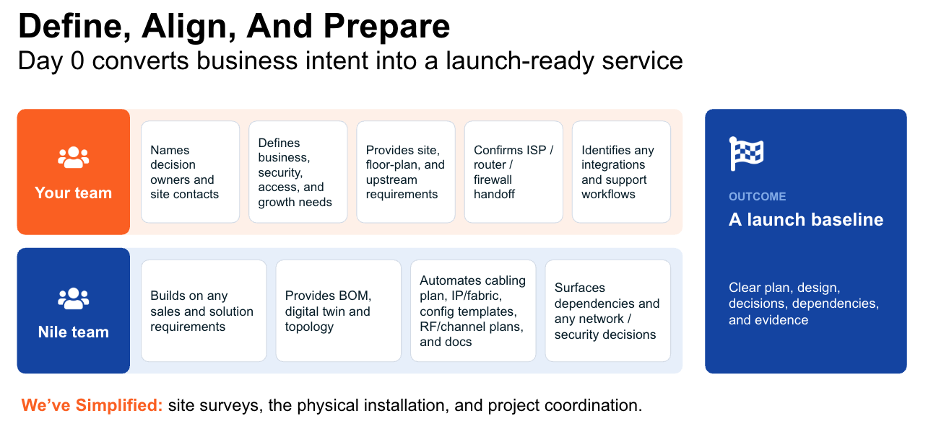
This collaborative approach delivers a fully validated deployment plan complete with an automated bill of materials, clear timelines, and identified dependencies—giving stakeholders complete transparency into equipment requirements, installation schedules, and key success metrics.
The result is a clear path from purchase order to a production-ready network that eliminates the old way of buying infrastructure and software licenses, and hoping that everything goes well.
Why Does Planning Determine Network Deployment Success?
Network deployments rarely operate in isolation. They rely on a complex web of dependencies that include accurate floor plans, physical cabling, power availability, WAN connections, and security policies, to name a few.
Gaps found during a deployment is a recipe for disaster.
Industry standards, such as the Wireless Broadband Alliance deployment guidelines, emphasize treating planning, site surveys, radio spectrum analysis, and design as integrated steps rather than isolated tasks. When these steps are cohesively handled, you eliminate costly surprises before an installation begins.
Nile equips your teams with specialized AI applications that transform complex design tasks into a unified, guided experience. While traditional deployment models often lead to frequent Day 1 issues due to fragmented management, network, and security tools, Nile integrates these domains into a single automated workflow that eliminates post-deployment fixes.
What Is the Business Value of Nile’s Approach?
In my opinion, front-loading discovery and validation steps, delivers clear, measurable advantages that transform how your business must approach deploying new wired, wireless and WAN networking infrastructure and software:
- Minimal Deployment Risk: Uncovers readiness issues ranging from missing power drops to rack capacity issues weeks before they turn into costly installation delays
- Accelerated Time-to-Value: Automated designs and bill-of-materials turn purchase orders into production-ready networks in record time
- Predictable Outcomes: Keeping every stakeholder aligned around a single source of truth, ensures what gets installed matches your exact security and operational goals.
Because Nile provides dedicated AI tools for Day 0 discovery, your team and partners can effortlessly map dependencies, verify site requirements, and generate precise deployment blueprints long before hardware arrives.
By leveraging AI automation across initial planning phases, Nile customers routinely achieve complete project launch within two weeks of booking—without the heavy manual lifting of traditional deployments.
How Does a Nile Project Kickoff Work?
Day 0 kicks off by bringing every key stakeholder together to build a detailed plan. Depending on the environment, this may include network and security leaders, IT operations, help desk, and facilities teams, along with the Nile Partner involved in the project.
This leads to a clear scope, including sites, milestones, responsibilities, and success metrics. A responsibility matrix outlines ownership for every decision, from open issues to acceptance criteria. Everything is locked in before field work begins.
How Does Early Discovery Data Lead to a Deployment Blueprint?
Legacy zero-touch provisioning (ZTP) tools focus narrowly on pushing firmware and basic configurations to switches and access points after they arrive on site. Nile takes a fundamentally different approach. Nile’s AI applications automate and validate all upfront planning, site discovery, and design work, ensuring complete architectural accuracy before equipment ever ships.
1. Business & Technical Requirements – Collaborative workshops define business objectives, application requirements, security expectations, and timeline constraints to form a high-level design and project plan.
2. Site Discovery and Infrastructure Readiness – Nile’s discovery tools rack space, power, cooling, cabling, and ceiling conditions to identify physical readiness gaps, to resolve them long before technicians arrive on site.
3. Wireless Planning and Survey – Nile’s predictive wireless surveys actively analyze floor plans, building materials, user density, and RF interference to pinpoint exact AP locations and coverage profiles effortlessly.
4. Wired Network and Resilience Design – Nile’s tools map switching topologies, port counts, uplinks, and high-availability redundancy, to support your business continuity and performance expectations.
5. Segmentation and Access-Control Mapping – Nile evaluates users, devices, and traffic flows, helping implement Zero Trust policies and microsegmentation directly into the core network architecture.
6. WAN and Internet Readiness – Internet circuits, WAN connectivity, IP addressing, routing, and DNS dependencies are evaluated, delivering a clear readiness plan that details prerequisite next steps.
7. Guest Access Planning – Onboarding, authentication, bandwidth controls, and compliance rules are built into the plan, eliminating post-activation workarounds.
8. Final Design and Deployment Plan – All input is placed into an actionable deployment package. Providing your entire organization everything required for a seamless rollout.
How Do Nile’s Day 0 AI Capabilities Connect to Day 2-N Operations?
Here’s where we’re different from traditional zero-touch provisioning (ZTP) tools. While other vendors expect you to hand them a wish list, we’ve taken a different approach.
The Nile Nav mobile app captures site and survey information, provides visibility into the physical environment, and supports the generation of deployment requirements. The information is used to produce a Nile Deployment Plan containing the proposed topology, bill of materials, and a detailed connectivity plan.
Automated BOM generation ensures all required network components and accessories—including switches, access points, sensors, optics, mounting hardware, and cabling specifications—are accurately accounted for upfront. This eliminates missing items and scope gaps that typically stall installations for days or weeks.
A site-specific Nile Digital Twin creates a virtual model of the planned network, connecting the approved design directly to the physical installation. This establishes a living operational baseline for Day 1 activation and ongoing Day 2-N lifecycle management, such as pre-validating the impact of future software updates.
What Is the Path to a Successful Network-as-a-Service Launch?
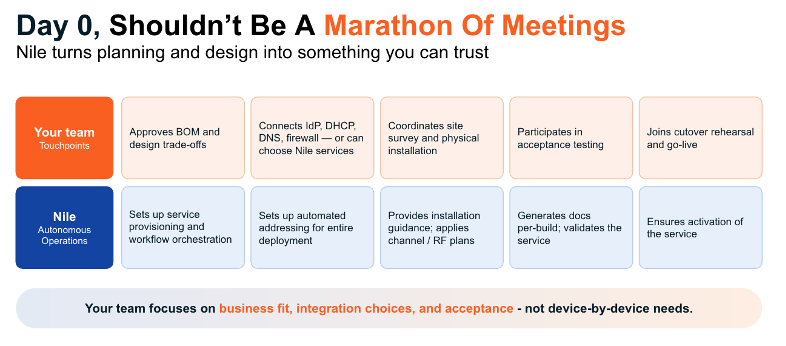
A smooth transition to Network-as-a-Service requires alignment and collaboration within your teams and Nile Partners. Active customer participation ensures the deployment aligns perfectly with your operational needs.
Together, the customer team and delivery teams focus on the following key areas to guarantee success:
- Aligning site and user cutovers to minimize operational disruption.
- Proactively identifying key workflows to keep business-critical applications connected throughout the migration.
- Establishing pre-approved change windows that respect business hours and uptime requirements.
- Ensuring legacy infrastructure and the new NaaS solution operate in harmony during the transition phase.
- Defining roles and responsibilities for every migration step to eliminate ambiguity on launch day.
- Incorporating structured verification steps to validate performance and security at every stage.
- Preparing detailed contingency and rollback procedures so business continuity remains fully protected.
- Keeping users, IT staff, and leadership informed through proactive, timely communication plans.
By locking in migration steps, maintenance windows, and contingency plans well before launch day, your team and Nile eliminate high-stress troubleshooting during production change windows—setting the stage for a seamless deployment whether upgrading existing sites or opening new locations.
How Do You Move From an Approved Design to a Validated Deployment?
For Day 1, Installation teams use Nile Nav and the approved deployment package to smoothly perform the on-site deployment. The installed topology is reconciled against the planned design, and deviations are identified for resolution.
Formal sign-off is easy to confirm assuring that the site is ready to enter production.
With a concise Day 0 plan, your organization has answers to the questions that typically create deployment uncertainty:
- What network will be built?
- Where will each component be installed?
- What site conditions must be made ready?
- What hardware and accessories are required?
- How will security and segmentation be implemented?
- How will an existing environment be migrated?
- Who owns every dependency?
- How will the completed network be validated?
- What must happen before the site can go live?
Are You Ready to Transform How You Rollout a Network?
Building out a new wired and wireless network shouldn’t be guess work. Every environment has unique hurdles, but if the right steps are taken, you can save time, money and finger-pointing. All it takes is a help from your friends at Nile.
Request a Demo to discover how Nile replaces legacy infrastructure and complex rollout processes with a modern, enterprise-grade network powered by Zero Trust security and AI-driven automation.