



A large percentage of enterprise-class networks today remain fundamentally rooted in legacy architectures that require manual interaction to keep running. Vendors added AI-powered capabilities to help reveal penitential issues with the promise of AI-generated alerts pointing IT teams to the exact step to manually perform to help them get ahead of problems more quickly.
While recommended “actions” saved some IT teams time, the sheer volume of alerts and required manual fixes was overwhelming. Beyond generating alerts, true automation was largely missing.
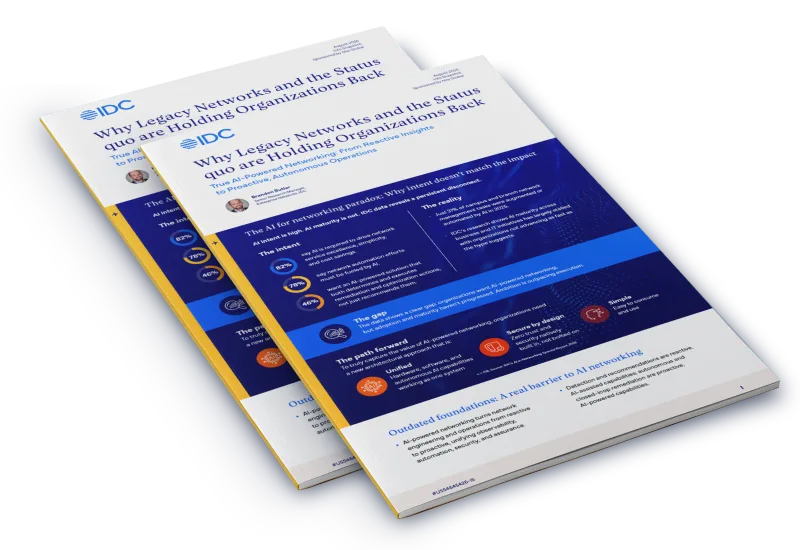
In a recent snapshot paper by IDC titled, “Why Legacy Networks and the Status Quo are Holding organizations Back”, it reveals a stark paradox in enterprise networking: while 82% of organizations acknowledge that AI is required to drive operational excellence and 78% insist automation must be fueled by AI, only 31% of campus and branch network tasks were actually automated or augmented by AI.
Ambition has drastically outpaced execution.
Why Doesn’t Intent Match the Impact?
Rather than merely making recommendations, IDC’s data highlights that 46% of organizations want an AI-powered solution that actively determines and executes remediation and optimization actions. IT teams do not need another dashboard issuing alerts or suggesting manual fixes, they need autonomous, closed-loop resolution workflows that they can trust.
However, legacy network infrastructure was never built to support true autonomous operations. The campus and branch networks running this legacy infrastructure are a patchwork of fragmented wired and wireless hardware, siloed management tools, and bolted-on security appliances.
These legacy networks lack the unified data and software foundation required for AI to safely perform closed-loop actions. Fixing an issue where every AP is running identical firmware is one thing, but in most legacy environments, a variety of infrastructure has been added along the way, making closed-loop remediation unpredictable.
When AI tools are layered on top of disjointed networks, they remain reactive “AI-assisted” advisors rather than proactive, autonomous operators.
Industry Report
Why Legacy Networks and the Status Quo are Holding organizations Back
A New Architectural Foundation: Unified and Autonomous
At Nile, we believe that a fundamental shift in the network architecture is required. You can’t solve an architectural problem with more legacy infrastructure, more firmware versions, and more upgrades and incremental add-ons.
To bridge the gap identified by IDC and achieve closed-loop autonomous operations, organizations must move to a modern architecture built around four critical pillars:
- Unified Architecture: Hardware, software, and AI capabilities must operate as a single, co-designed full-stack service across wired and wireless environments. By eliminating legacy engineering silos, AI can generate workflows based on a foundation and telemetry that works across environments.
- Autonomous Closed-Loop Operations: True AI networking transitions operational tasks from reactive recommendations to proactive, validated, closed-loop execution. An autonomous network detects anomalies, determines the safest fix, and executes remediation instantly without waiting for human intervention.
- Network-as-a-Service Consumption: Complex legacy licensing and fragmented hardware refresh cycles hinder automation. An all-inclusive NaaS model removes operational overhead, ensuring the infrastructure and software were designed to deliver deterministic outcomes.
- Native Zero Trust Security: Lastly, security must not be forgotten. Zero Trust principles; including default-deny access, continuous identity verification, and automatic layer-3 micro-segmentation must be woven directly into the unified network fabric to avoid the issues identified above.
The Threat Environment Has Accelerated—Legacy Defense Has Not
The architectural gaps described above, become a dangerous vulnerability when facing modern cyber threats. AI-generated threats operate rapidly, testing network parameters and exploiting micro-vulnerabilities across the network edge where users, IoT devices, and autonomous machines connect.
When an anomaly occurs, if AI flags an alert in a traditional network, IT is again left to manually isolate affected switch ports, reconfigure VLANs, and quarantine a device. In a world where AI can execute attacks in milliseconds, manual remediation is effectively no protection at all. A disparate foundation ultimately creates blind spots across the network, slowing down resolution and exposing organizations to catastrophic outcomes.
A modern architecture extends the ability for closed-loop operations to automate threat containment as well, drastically reducing the time needed to contain an out of compliance device or breach.
Unlocking IT Productivity and Resilience
When organizations embrace a natively unified, autonomous architecture delivered-as-a-service, the benefits extend far beyond the simplification of a network and security posture. Trusted closed-loop remediation can then reduce manual optimization tasks and trouble tickets significantly, freeing IT personnel from mundane firefighting.
The Path Forward
IDC’s research shows the status quo is no longer viable. To combat complexity, lean IT and fast-moving cyber threats, IT and business leaders must rethink the network
architecture they’re deploying to truly recognize the benefits of AI-powered autonomous operations.
Nile leads this shift with a secure Network-as-a-Service (NaaS) designed for the AI era.
Learn More