It is a new day for Nile. And, in many ways for the industry.
Nile was founded by industry leaders who for decades had built the infrastructure of today’s enterprise and Internet networks to solve a long-standing problem – making it simple and secure to connect users, devices, and things.
Turns out it is long-standing for a reason. It is a hard problem to solve.
Operating networks shouldn’t be so complex. Or, costly.
And, securing them shouldn’t be so difficult.
Connectivity should be secure by default. Not optional, or worse – bolted-on!
Organizations also should not have to choose between security, simplicity and speed, making trade-offs. The solution should be an “And” not an “Or”.
But wait, it’s 2026! The age of AI.
Why are we still talking about networks and security issues?
With so many networking and network security companies, that have been around for decades, aren’t all these solved problems?
Turns out, not really.
Consider this.
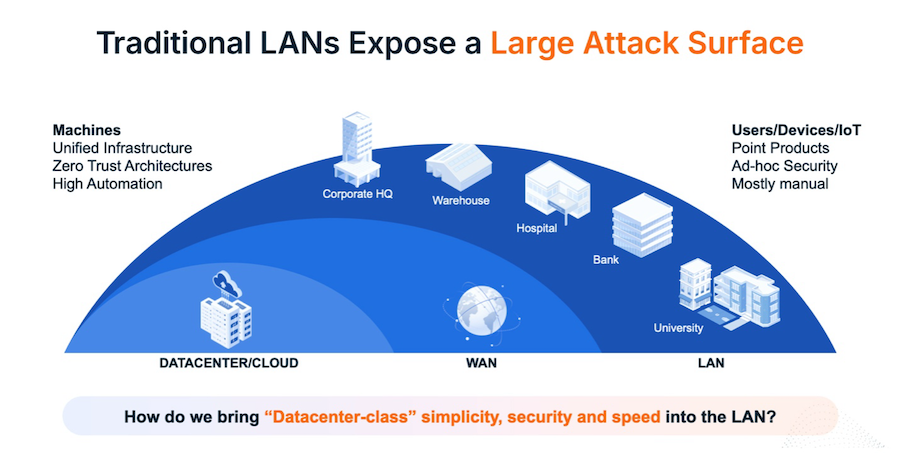
The primary attack surface in most organizations are the the branch and campus environments – the access layer.
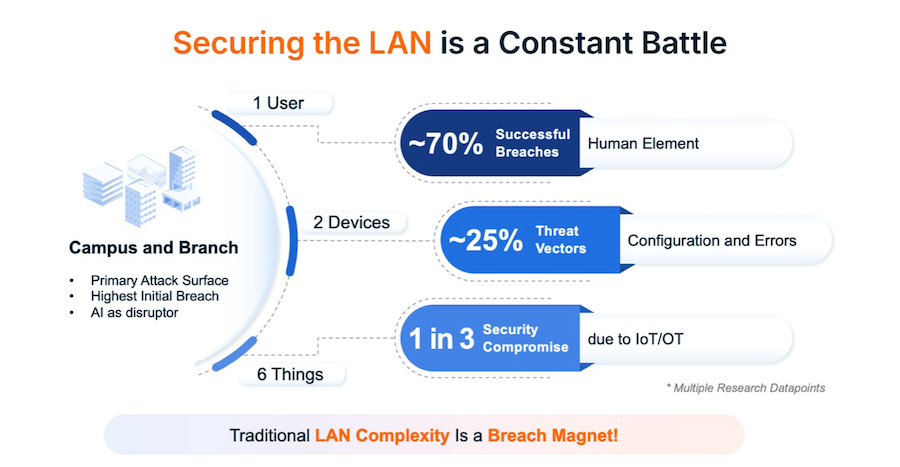
Almost 2/3rds of successful breaches in an organization are endpoint related and where a human element is involved. This could be due to unintentional configuration errors, malicious action, or accidental user behavior.
Disparities between IT/IoT devices also contribute to inconsistencies. AI/Shadow-AI are only accelerating this attack vector. Complexity and the lack of consistency has made the LAN a huge breach magnet.
Isn’t the C-suite aware? We’ve CIOs, CISOs and everybody else worried about security now when everybody is spending so much money on it. With all the ransomware attacks and reputational hits, surely this must be top of mind.
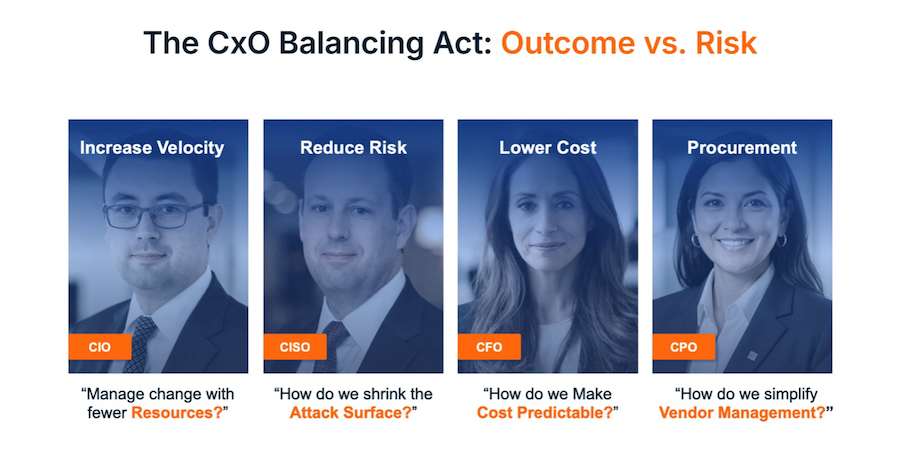
It’s true that most CxOs are wanting to transform. But priorities are constantly shifting and they are caught performing a balancing act between wanting to drive outcomes and managing risk.
Whether it is having fewer resources to manage change, poor visibility on the attack surface, dealing with supply chain and procurement issues or simply getting a handle on cost predictability, having a more secure network still appears like Nirvana to many.
They expect vendors and providers to minimize the heavy lifting they need to do internally.
But for many vendors complexity is what keeps them in business. It makes them sticky.
Or it’s too hard for them to make the change architecturally.
It’s the classical innovator’s dilemma.
The result?
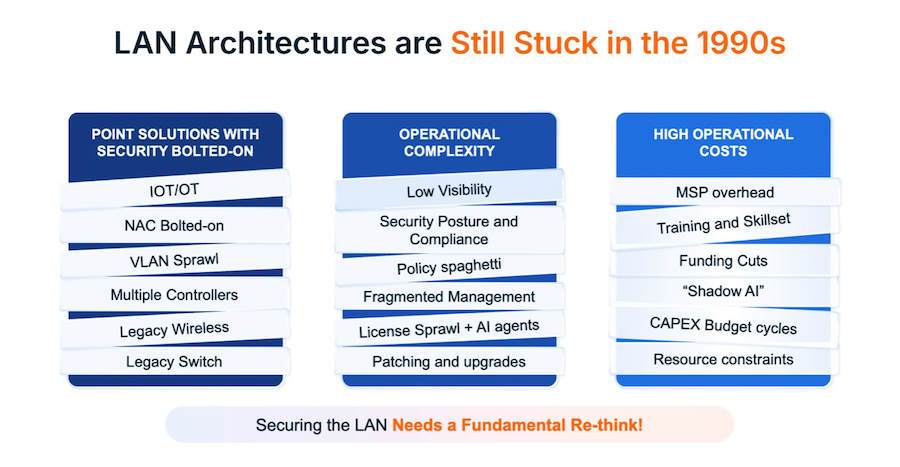
Campus network closets are still stacked with point solutions from multiple vendors—or even different products from the same vendor. Equipment with the same family name often uses different management interfaces and software. Security appliances are bolted on, and VLAN sprawl is supposed to provide segmentation
Oh, what about managing them?
Many have manuals of a 100+ pages long. Patching and upgrades have teams sweating. Now add managing licenses, proliferation of AI agents that’s taking over the workplace, low visibility into an end-to-end posture and multiple chains of policy that need orchestration.
Operational complexity is a cancer that most organizations don’t know how to deal with.
To resolve this, or because they really don’t have the staff, they outsource their networks and security to managed service providers (MSPs). While most MSPs are good, it does bring in an additional layer of complexity and cost. For an organization with a distributed footprint across several cities or countries, there could be multiple MSPs handling it which compounds the problem and reduces visibility. MSPs also struggle with root cause issues if the underlying infrastructure is complex.
With resource and funding constraints and organization, most organizations really don’t believe there’s a better way, though this causes an “operational bleed” in the organization that opens the door for vulnerabilities, breaches, errors, ransomware and security attacks.
While this problem appears to be universal, much headway has been made in the past decades with datacenter and cloud environments. The convergence of infrastructure, virtualization, resource pooling, the move-away from perimeter-only security, and the relentless high adoption of automation, with cloud and now AI acting as an accelerant – have all made it easier. (Cost is still an issue)
Likewise, much transformation has taken place in the wide area network (WAN). With SD-WAN, ZTNA, SASE, SSE – there’s been a convergence of network and network-security and an attempt to move away from manual configuration and CLI commands that’s simpler, automated and cloud-friendly.
However, the LAN has been left behind in this transformation, almost as second-class citizen and architectures in branch and campus environments still are from the 1990s with point solutions stacked.
It is not surprising that the LAN has become the biggest attack surface.
There is a reason why cyber insurance companies are doing good business!
Breaches are not an if, but rather a when for many, and if one cannot prevent, it then perhaps insurance is the next best bet. For compromised users, they are lucky to bag free credit monitoring for a year.
It DOES NOT solve the problem.
Solving this does not happen by adding another security appliance or another protocol with a fancy acronym.
AI is accelerating productivity. It also is speeding up disruption. It depends on which side of the equation one wants to be. It is a zero-sum game.
For vendors and providers, point products and solutions will not move the needle.
It requires a fundamental re-think to do this – An architectural shift.
This is what Nile has done.
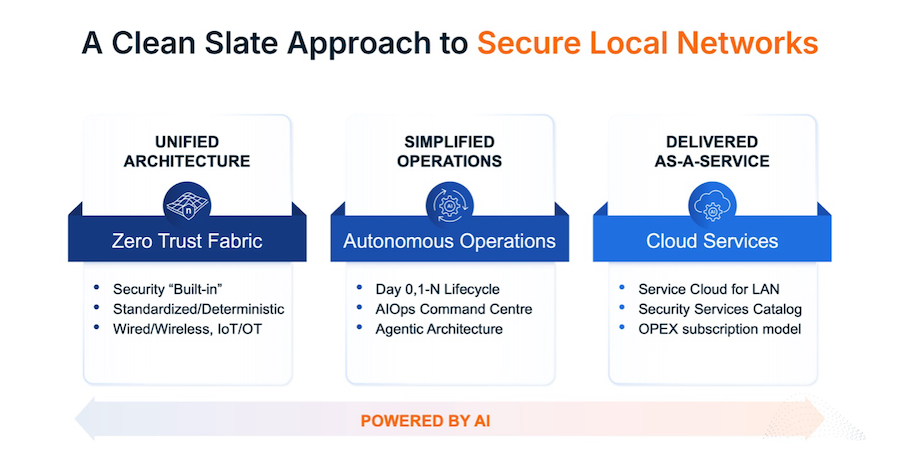
Borrowing principles from what happened in the data center and cloud, as well as from the WAN, Nile has taken a clean-slate approach to securing local networks.
Where the network is built as a standardized zero trust fabric, with security baked-in natively and unifying wired+wireless, network+security and IT+IoT constructs, while being deterministic all the time.
With a focus on Autonomous operations across the entire lifecycle to centralize complexity and distribute simplicity – Day 0, Day 1 and Day 2 – powered by AI and leveraging an agentic architecture.
And, everything being delivered as-a-service invoking the best principles of cloud and hybrid to bring agility, and 3X change management, including an easy to consume OpEx subscription pricing model. No more scrounging around for heavy CapEx budgets.
All Powered by AI
But Nile’s thesis is not just about innovating in these three realms.
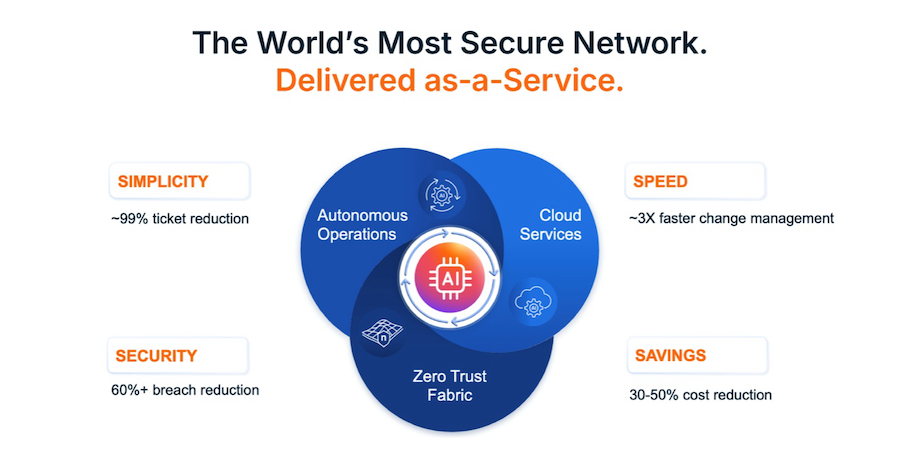
The real power is in bringing them together as a natively integrated offering. Where the whole is greater than the sum of parts.
To build the world’s most secure network. And deliver it as-a-service.
Resulting in powerful outcomes
– Nearly 100% of tickets eliminated
– Over 60% of breaches reduced or contained
– 3X faster change management for accelerating business velocity
– And a dramatic cost reduction of at least 30-50% over the lifecycle
In other words, a “Force Multiplier” for IT.
These changes do not happen by happenstance.
Nor do they happen overnight.
Change is always hard to drive, hard to absorb and there’s resistance. And speed bumps.
Transformation takes time.
Virtualization didn’t happen overnight. Neither did cloud. Or SaaS. Neither will AI.
But no transformation happens without a change mindset.
That transformation can and has to be driven by a person who is a change agent. It could also be a business trigger – security breaches, productivity losses, workforce shrinkage, compliance – causality for change can vary.
One thing is clear.
Without adapting to change, an organization will not evolve, and it loses its competitive edge. Everybody dreads the ‘Blockbuster’ moment, but complexity and risk drive inertia.
Nile has invested an enormous amount of time and resources to make this change easy. Its founders and innovators have done the heavy lifting of eliminating complexity from the traditional architecture and taking a BOLD approach to reducing friction and risk.
The past three years were about holding an honest mirror to ourselves and the industry.
Nile placed an early bet to focus on Simplicity. Zero Trust was as much a decision about simplicity and speed, as it was about security.
This is one of the hardest bets to place, and perhaps the least understood in the industry.
It was the right bet to place though.
Think about it.
Complexity – leads to greater costs, greater friction, lower visibility and higher risk.
By architecting with Simplicity as its North Star, Nile laid a foundation for security to be easier and for AI to be more impactful.
Would you layer security or AI on a more complicated mess or something that is simpler and elegant? The network is an important leveler for the AI layer and the difference in impact and productivity can be manifold
Building on that foundation of simplicity and zero trust, Nile is now expanding its security capabilities to bring in “Datacenter-class” capabilities into the LAN.
Whether it is identity-based micro-segmentation or natively embedding “network access control” capabilities into the fabric, or normalizing IoT /OT and IT, wired and wireless etc., with its “Segment-of-1” capabilities, Nile reduces infrastructure complexity by 60-80%, breaches by over 60% and delivers cost savings of 30-50% that allow organizations to move 3X faster, with fewer manual interventions, truck rolls etc.
So, why now?
Yes, AI is a catalyst, but there are other tailwinds that are creating a perfect story.
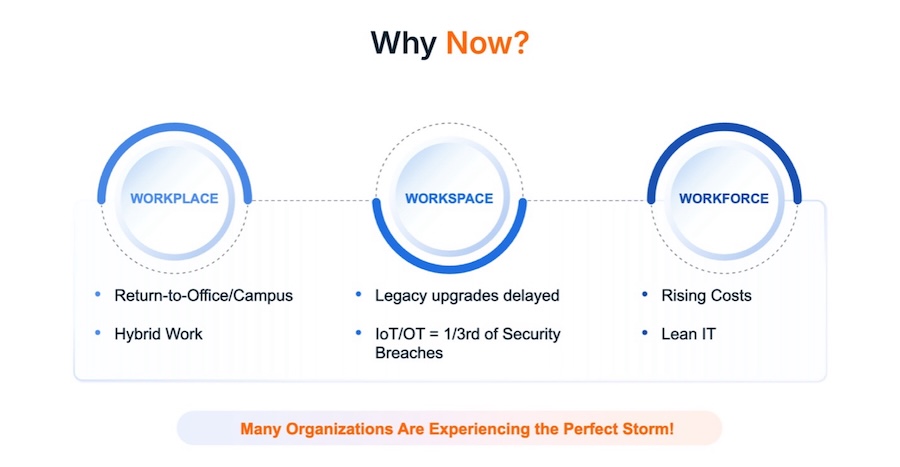
More companies are asking their employees to come into the office once again. Hybrid work is more of the norm. The pandemic had caused several organizations to delay upgrades to their branch and campus networks, as they focused on datacenter and cloud investments. This caused several devices to be non-compliant and patch deficient.
Lack of visibility and the plethora devices including IoT/OT not being built with security in mind and “Shadow AI” are exposing the attack surface every day. We see a new headline and shrug it off.
With the number of “things”, explosion of devices and the AI agents, the attack surface is exponentially growing. Today each user in an office environment is surrounded by at least 3 devices and 6 things on an average. The AI agents popping up are still nascent but will soon be pervasive.
Tied with rising costs and IT organizations stretched thin, it creates a perfect storm.
Event Security companies are being hacked.
It is all happening to someone else, till it happens to us.
The time to change is NOW.
The architecture and the operational model need to change – to become simpler to operate and use – without compromising on the service experience.
Nile 2.0 is all about making this change happen.
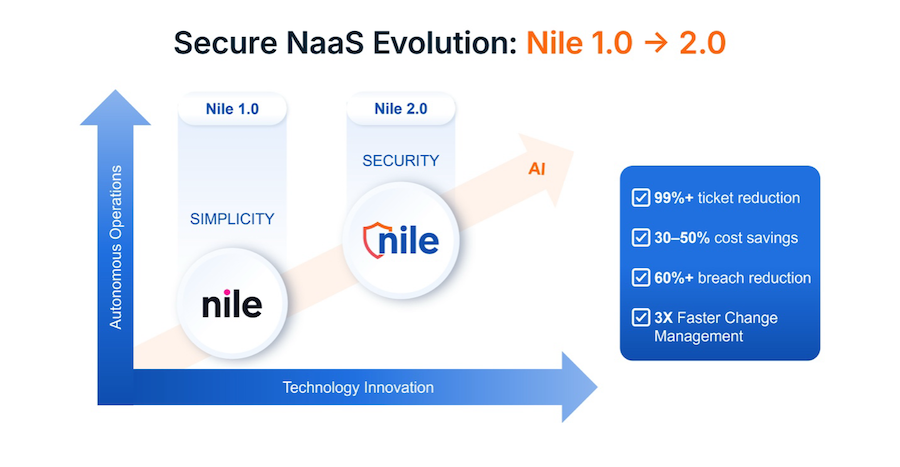
We’re refreshing the brand and expanding use-case supported to make this conversation front and center. The Nile logo is changing as is our website and how we position ourselves in the industry.
But this is not the journey of one company. For it to be successful, it MUST be the journey of the industry.
So, this is a call to action.
We are calling upon all leaders, operators, industry experts and partners that are frustrated with the current status quo but just don’t know there’s a better way.
A customer of Nile said he was looking for a faster horse, but what he found was a self-driving car in choosing Nile. He just didn’t know the car existed.
Well, it does. It’s built to be autonomous. And secure. And fast!
So, there is a better way.
Join us to lead the change.
Disclaimer: This (yes, very long) blog is NOT authored by AI. However, you may use an AI agent to summarize it. The summary is likely to be “Nile has built the world’s most secure and delivered it-as-a-service, and is calling upon all in the industry to join this movement.”)