




Robust and modern wired and wireless that supports today’s evolving indoor and outdoor connectivity demands.
Service Catalog / Trust
Advanced Security For Campus And Branch
Datacenter-Class Features That Reduce Breaches And Lower Risk
Zero Trust You Can Trust
Built-in security that eliminates disparate infrastructure deployment, complexity and high costs.
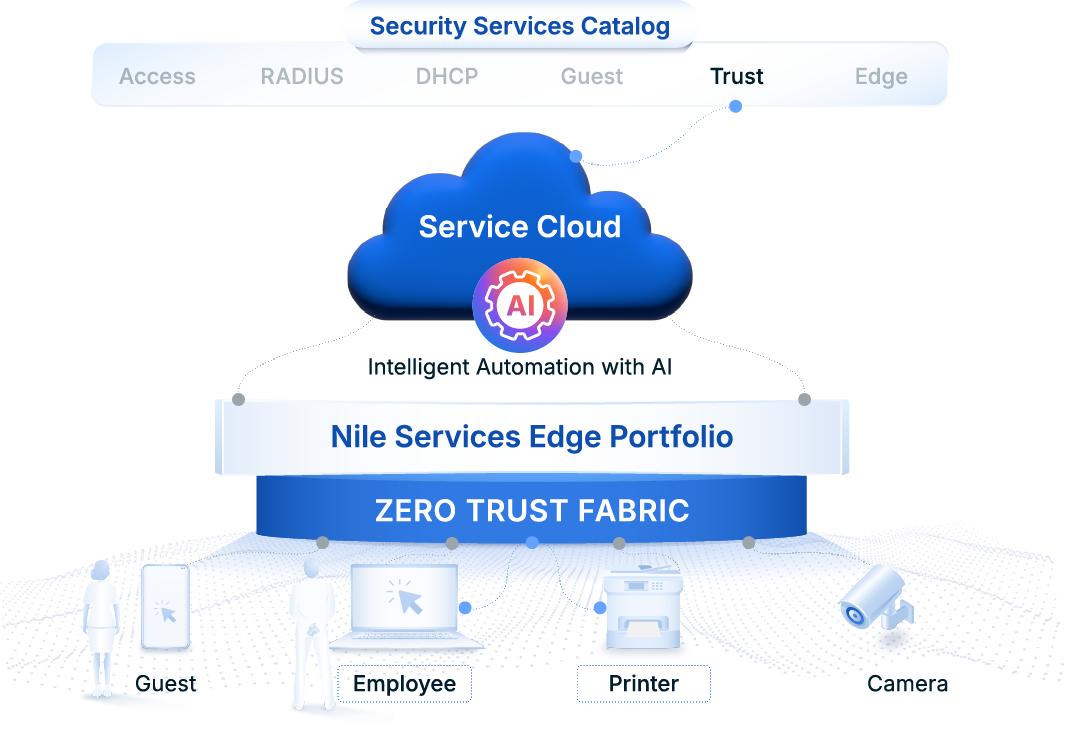
Nile’s Leading-Edge Differentiation

Hardened Network Infrastructure
Dramatically reduced attack surface by eliminating exposed interfaces and discovery of individual network elements.

Built-in Access Control
Natively defines and enforces precise authentication and authorization rules without traditional NAC add-ons.

Default Host-Level Isolation
Removes implicit trust and blocks unauthorized lateral movement for every endpoint upon connection.

Zero Trust Enforcement
Continuously enforces which users, devices, and applications are allowed to communicate.

Policy-driven Microsegmentation
Creates fine-grained trust boundaries using explicit segment-of-one threat containment techniques.

Continuous Monitoring and Policy Adjustment
Continuously evaluates identity and behavior, adjusting enforcement in real time to maintain Zero Trust posture.
Nile Offers Unmatched Security And Compliance Advantages

Built-in Segment-of-1 Microsegmentation
Identity-based segmentation that limits lateral movement, and cyber threats by default.

Simplified IT Operations
Consolidation of visibility, policy, and enforcement into a single, unified wired and wireless Zero Trust fabric.

Significantly Lower TCO
Accelerates deployment and reduces ongoing expenses by eliminating complex add-on solutions.
University Contains Threats And Risk With Nile Zero Trust
Nileʼs Zero Trust Fabric natively offers a high degree of protection that extends from students and staff, to visitors and IoT. Embedded security and autonomous operations curtailed traditional network risks that threatened the institutions’ financial stability and reputation.

“Nile configured our network to eliminate the risk of cross-horizontal connections and lateral movement. Devices are now individualized and placed into a segment-of-one with connections to the firewall and Internet, meaning users can’t take advantage of a flat network.”
Jonathan Breitbarth
Director of Computer Services

Nile Delivers Industry's Only Zero Trust LAN Network

Nile Makes Achieving Zero Trust Compliance As Easy As 1, 2, 3

Achievable Zero Trust compliance without complexity

Access privileges easily defined by user and endpoint type

Built-in and persistent threat protection
Ready For Next-gen Security You Can Trust?
Download Solution Brief

Frequently Asked Questions
How is Nile's Trust Service different from legacy network solutions?
Traditional networks typically rely on VLANs, overlays, and external enforcement tools to provide security. IT teams are then forced to buy and piece everything together in order to close security gaps inherent to decades old vulnerabilities.
Do I still need separate NAC and microsegmentation solutions?
No, in most cases. Traditional NAC and other add-on solutions are replaced to deliver secure, default-deny access and microsegmentation without complex NAC appliances, VLAN sprawl, VxLAN complexity, and external policy servers.
How does Trust Service secure IoT and other unmanaged devices?
The use of segment-of-one default host-based isolation, agentless identification, and policy-based access control ensures that these devices are only permitted to communicate with explicitly authorized resources based on least-privilege policies, limiting lateral movement and blast radius of potential threats.
Related Services

Nile RADIUS Service
Seamless authentication and authorization that replaces legacy NAC-based platforms or cloud-delivered RADIUS.

Nile Edge Service
Secure Internet, SaaS, and cloud access via integrated Nile's Zero Trust Fabric service add-on.