




Robust wired and wireless that supports today’s evolving indoor and outdoor connectivity demands.
Service Catalog / Edge Service
Secure, Integrated Edge Connectivity
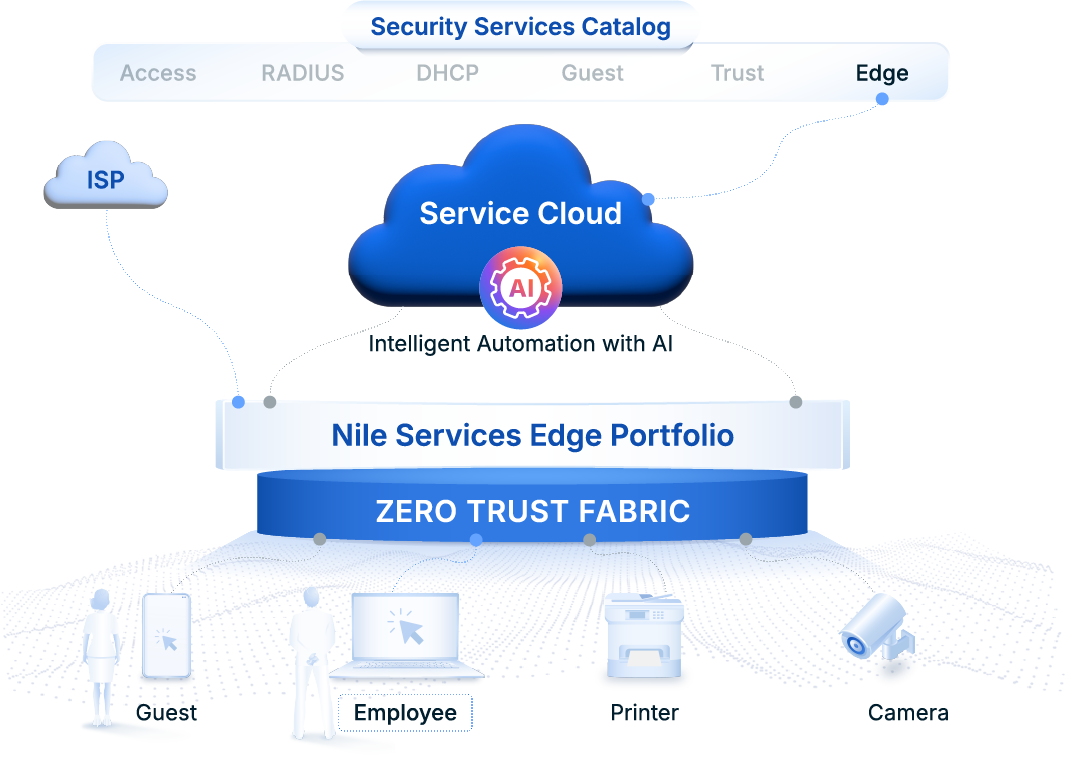
Simple WAN service without on-prem firewall and SD-WAN appliances
Next-gen WAN Connectivity And Lifecycle Management
Simple to use and manage Internet and WAN connectivity without traditional add-on appliances, cost and IT burden.
Nile’s Leading-Edge Differentiation

Adaptive Path Selection
Autonomously steers traffic in real-time based on changing conditions, without static roles or predefined paths.

Self-Optimizing Operations
Eliminates ongoing configuration and policy maintenance by continuously optimizing behavior.

Multi-Link Intelligence
Supports multiple connectivity options terminating on Nileʼs Zero Trust Fabric, for real-time link quality and performance.

Usage-Aware Routing
Accounts for bandwidth limits and usage trends to prevent congestion and avoid overages.

Native SSE Integration
Forwards traffic directly to cloud-delivered security services edge (SSE) without the need for additional appliances.

Simplified Operations
Designed, deployed, and operated through a single, standardized operating model—eliminating separate tools, and lifecycle overhead.
Nile Offers Unmatched IT And Business Advantages

Zero Trust By Design
Native Nile Zero Trust services offer security without additional appliances, reducing attack surface and complexity.
Built-in Operational Simplicity
Standardized architecture and autonomous operations eliminates manual configuration, ongoing tuning, and per-site manipulation.

Faster Time to Value
Less integration results in shortening rollout timelines, lowering operational and lifecycle expenses.
Internet Connectivity Without SD-WAN Complexity
Built-in Edge service streamlines WAN connectivity, eliminating separate hardware, software and management across 30+ locations, for significant cost and time savings.

“Nileʼs Edge Service gives us a network with built-in capabilities that streamlines offering end-to-end access to internet and cloud services—without involving and managing multiple platforms, vendors, or service providers.ˮ
Vice President
Technology Operations
Nile Makes WAN Connectivity As Easy As 1, 2, 3

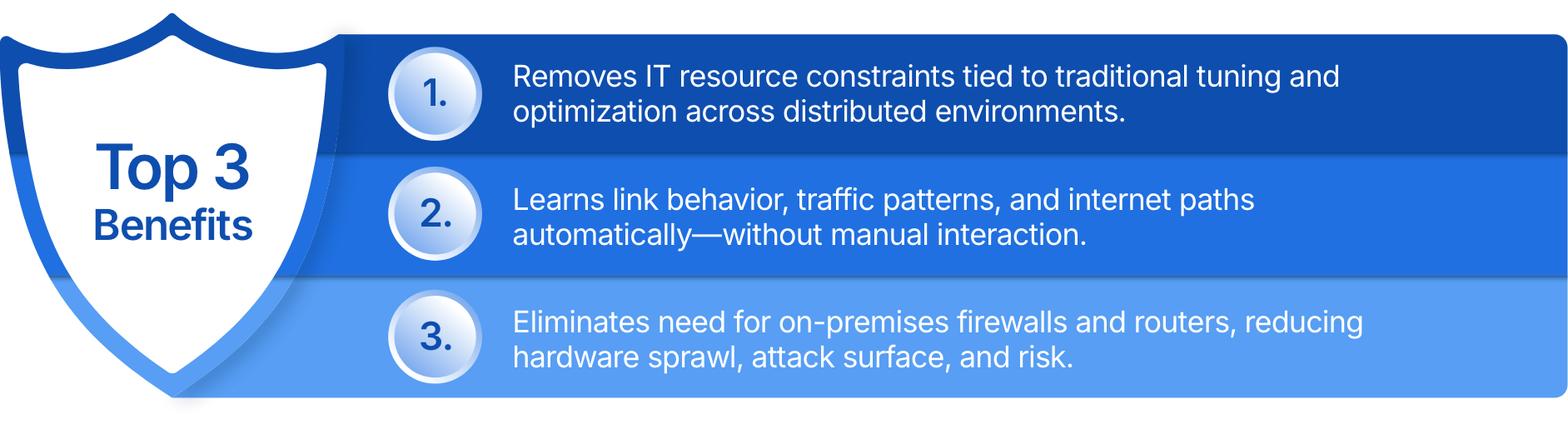
Service leverages existing Nile hardware and requires minimal IT interaction to activate.

Links, WAN providers, and performance characteristics are automatically identified.

Traffic behavior is continuously optimized based on real-world conditions.
Ready To Refresh Your WAN Service?
Download Solution Brief

Frequently Asked Questions
Why does Nile offer an integrated WAN Service?
The Nile Edge Service allows customers to offload traditional firewall and SD-WAN responsibilities and burden. By providing autonomous connectivity that natively resides within the Nile Trust Service Fabric we’ve removed policy management, SLA tuning, and manual WAN optimization from day-to-day operations.
What happens once I initiate a Nile Edge Service subscription?
Once subscribed, WAN connectivity is automatically enabled. Basic WAN contract information, including circuit details, start dates, and contracted speeds is all that is needed. Autonomous functions discover internet providers, monitor link performance, and begin optimizing traffic with no operational overhead.
How does traffic get routed without traditional WAN policies?
Edge Service continuously evaluates link performance, utilization, and observed internet behavior to dynamically select optimal paths. Mission-critical traffic is preferentially placed on higher-quality circuits, while non-critical traffic is opportunistically routed over secondary links—all without static rules, priorities, or manual intervention.
Related Services

Nile Guest Service
Secure cloud-delivered guest access that adds an extraordinary new level of on-line security and performance.

Nile Trust Service
Built-in Zero Trust security at every level that delivers secure access, malware protection and compliance protection.