










Solutions for Decision Makers / CISOs
Nile for CISOs
Shrinking the Attack Surface, Strengthening Security Posture
The CISO Challenge
Defend a Growing Attack Surface and Reduce Risk with Fewer Resources
Today’s CISOs are accountable for protecting the business while the attack surface keeps expanding – and they must do it with constrained budgets, lean teams, and growing scrutiny from boards, auditors, and regulators
Top Challenges
-
1
Expanding Attack Surface
Hybrid work, IoT/OT, unmanaged devices, shadow IT
-
2
Lateral Movement and Ransomware
Fueled by implicit trust in the LAN
-
3
Fragmented Security Stacks
NAC, segmentation, firewalls, monitoring solutions that don’t integrate. Drive complexity and unforced errors
-
4
Compliance Pressure
Across SOC 2, ISO 27001, HIPAA, PCI DSS, NIST CSF, and new regulations
-
5
Talent Shortage and Alert Fatigue
Limit 24/7 detection and response
-
6
Limited East-West Visibility
Across campus and branch networks

Bottom Line
Bolting security onto a legacy LAN leaves gaps that attackers exploit – and that auditors find. Modern CISOs need a new solution
Built for Outcomes
Nile delivers a secure, autonomous NaaS platform that built on a strong zero-trust architecture, cloud delivered services and autonomous operations
The Nile Approach
Zero Trust Built-In, Not Bolted-On
Nile delivers a secure-by-design, autonomous Network-as-a-Service platform with Zero Trust built into the fabric - shrinking the attack surface, containing breaches, and eliminating the operational tax of stitched point products
-

Identity-based Micro-segmentation
“Segment-of-One” fabric
-
End-to-end Encryption by Default
Across the LAN, with automatic security updates and patching
-
Unified, Real-time East-West Visibility
Across entire network infrastructure
-
Native NAC Replacement
Built into the fabric
-
Continuous Authentication
With predictable, subscription-based pricing and continuous modernization included
-
Native Integrations
With Microsoft Entra, Palo Alto Networks, and Zscaler for end-to-end policy management

“Leveraging Nile’s Zero Trust based architecture has significantly strengthened our security posture. Its built-in host isolation and micro-segmentation capabilities provide advanced lateral security to effectively reduce malware propagation and lower risk for business operations.”
Dean Lochkovic
COO, People Driven Technology
Why Legacy Network Security Increases Your Risk
Legacy Approach
- Implicit trust inside the LAN
- Bolt-on NAC, segmentation, and monitoring tools
- VLAN- and IP-based segmentation
- Manual patching and firmware cycles
- Limited east-west visibility
- Reactive incident response
Security Exposure
- Lateral movement enables ransomware to spread quickly
- Stitched architecture with policy gaps and integration overhead
- Static, coarse-grained, and easily bypassed via spoofing
- Long vulnerability exposure windows between updates
- Blind spots across IoT, OT, and unmanaged devices
- Higher MTTD/R and a larger breach blast radius
The Nile Difference

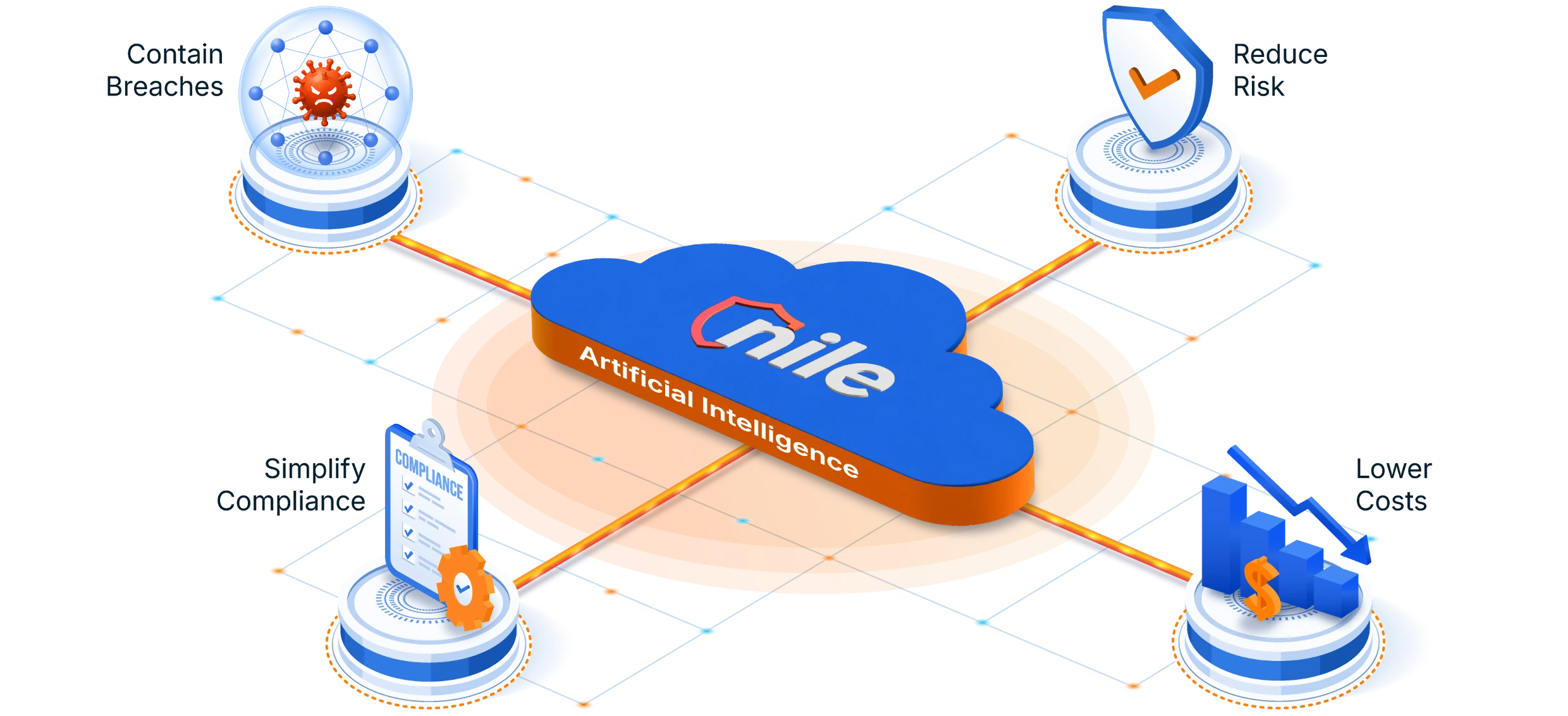
Shrink the Attack Surface
Zero Trust by default across every user, device, and IoT endpoint cuts breach exposure by 60-100%

Contain Breaches with Segment-of-One
Identity-based microsegmentation isolates every device, limiting blast radius and cutting ransomware / lateral-movement risk - with AI-driven detection that lowers MTTD/R

Eliminate Stitching and Stack Sprawl
Native NAC, segmentation, and access control replace standalone appliances, cutting cost and complexity by 30-70%

Simplify Compliance and Audit
Always-on, identity-aware enforcement with built-in logging keeps you audit-ready across SOC 2, ISO 27001, HIPAA, PCI DSS, and NIST CSF

Gain Full East-West Visibility
Unified, real-time view across users, devices, and things, managed from a single platform

Let Security Teams Focus on Threats, Not Tickets
Autonomous operations and automatic patching remove manual configuration and stitching work, freeing your team for real threats and higher-value work
Old Way vs. Nile Way
| Capability | Legacy Architecture | Nile Secure NaaS |
|---|---|---|
| Trust Model | Implicit trust inside the LAN | Zero Trust by default (identity-first) |
| Segmentation | VLAN / IP-based, static | Identity-based microsegmentation (Segment-of-One) |
| Access Control | Standalone NAC appliances | Native NAC built into the fabric |
| Patching & Updates | Manual, scheduled windows | Automatic, continuous |
| Encryption | Optional, inconsistent | End-to-end by default |
| Visibility | Fragmented across tools | Unified, real-time east-west |
| Operations | Manual, reactive | Autonomous, AI-driven |
| Compliance Support | Point-in-time, evidence-gathering | Continuous, enforced by design |
| Time to Deploy | Months | Days / weeks |